a gas is placed into a 2 l container. the temperature of the container is set at 300 k and the pressure of…
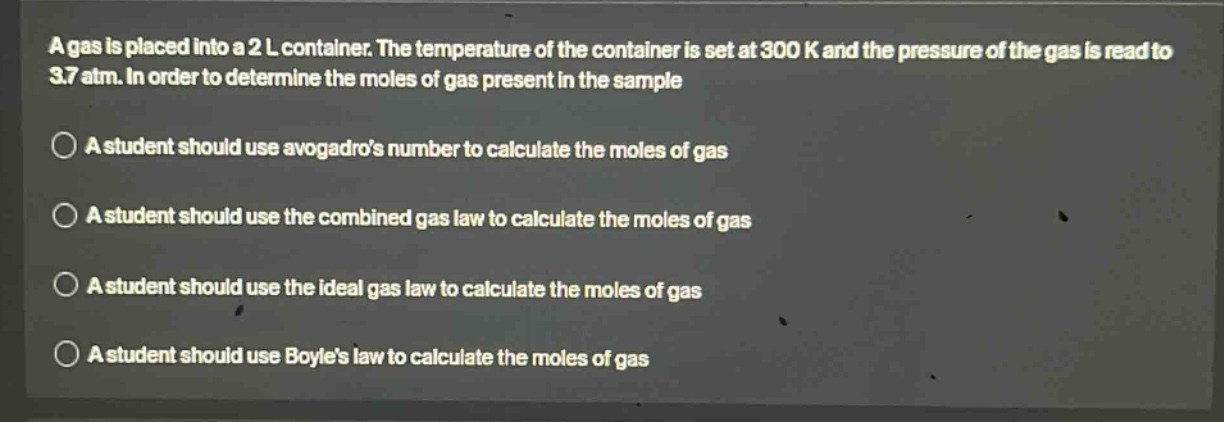
a gas is placed into a 2 l container. the temperature of the container is set at 300 k and the pressure of the gas is read to 3.7 atm. in order to determine the moles of gas present in the sample\na student should use avogadros number to calculate the moles of gas\na student should use the combined gas law to calculate the moles of gas\na student should use the ideal gas law to calculate the moles of gas\na student should use boyles law to calculate the moles of gas
Answer
Explanation:
Step1: Recall gas - law concepts
Avogadro's number is used for converting between number of particles and moles, not for this scenario. The combined gas law ($\frac{P_1V_1}{T_1}=\frac{P_2V_2}{T_2}$) is for changes in pressure, volume and temperature of a gas sample. Boyle's law ($P_1V_1 = P_2V_2$) relates pressure and volume at constant temperature. The ideal gas law is $PV=nRT$, where $P$ is pressure, $V$ is volume, $n$ is the number of moles, $R$ is the ideal - gas constant and $T$ is temperature. Given $P = 3.7$ atm, $V=2$ L, $T = 300$ K and $R=0.0821$ L$\cdot$atm/(mol$\cdot$K), we can solve for $n$.
Answer:
C. A student should use the ideal gas law to calculate the moles of gas