given the equation representing a phase change at equilibrium: h₂o(s) ⇌ h₂o(ℓ)\nwhich statement describes…
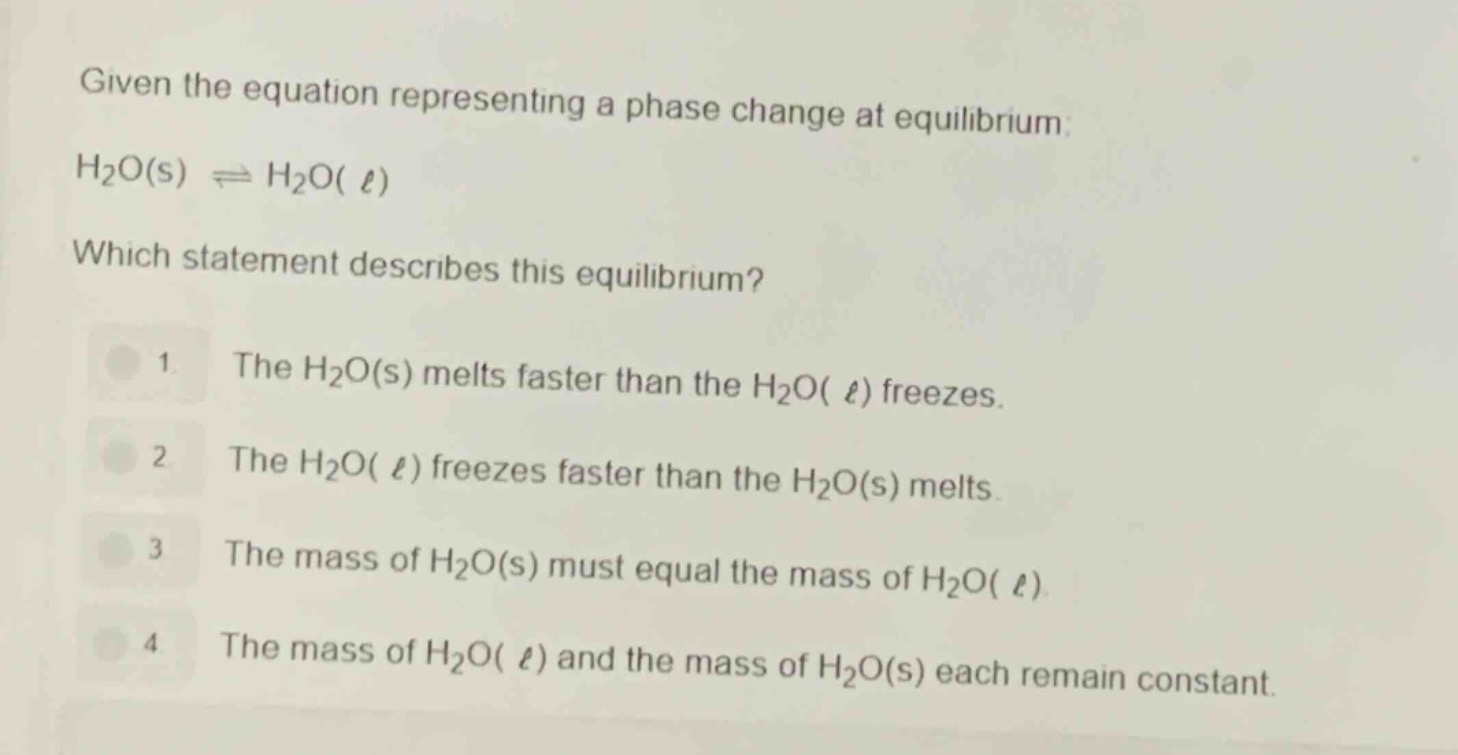
given the equation representing a phase change at equilibrium: h₂o(s) ⇌ h₂o(ℓ)\nwhich statement describes this equilibrium?\n1 the h₂o(s) melts faster than the h₂o(ℓ) freezes.\n2 the h₂o(ℓ) freezes faster than the h₂o(s) melts.\n3 the mass of h₂o(s) must equal the mass of h₂o(ℓ).\n4 the mass of h₂o(ℓ) and the mass of h₂o(s) each remain constant.
Answer
Brief Explanations:
At equilibrium, the forward and reverse processes occur at the same rate. In the phase - change equilibrium of water ($H_2O(s)\rightleftharpoons H_2O(l)$), the rate of melting of ice ($H_2O(s)$) is equal to the rate of freezing of water ($H_2O(l)$). As a result, the mass of $H_2O(s)$ and the mass of $H_2O(l)$ do not change over time and remain constant.
Answer:
- The mass of $H_2O( \ell)$ and the mass of $H_2O(s)$ each remain constant.