given the system at equilibrium: 2pcl₅(g) + energy ⇌ pcl₃(g) + o₂(g) which changes occur when o₂(g) is added…
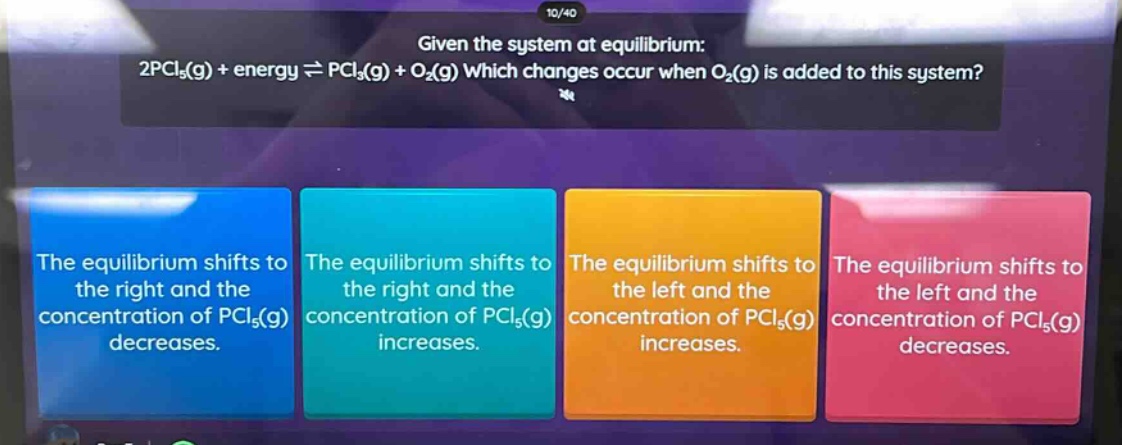
given the system at equilibrium: 2pcl₅(g) + energy ⇌ pcl₃(g) + o₂(g) which changes occur when o₂(g) is added to this system? the equilibrium shifts to the right and the concentration of pcl₅(g) decreases. the equilibrium shifts to the right and the concentration of pcl₅(g) increases. the equilibrium shifts to the left and the concentration of pcl₅(g) increases. the equilibrium shifts to the left and the concentration of pcl₅(g) decreases.
Answer
Answer:
The equilibrium shifts to the left and the concentration of $\text{PCl}_{5}(\text{g})$ increases.
Explanation:
Step1: Apply Le - Chatelier's principle
According to Le - Chatelier's principle, when a stress is applied to a system at equilibrium, the system will shift to relieve the stress.
Step2: Analyze the added substance
Here, $\text{O}{2}(\text{g})$ is added. Since $\text{O}{2}$ is a product in the reaction $2\text{PCl}{5}(\text{g})+\text{energy}\rightleftharpoons\text{PCl}{3}(\text{g})+\text{O}_{2}(\text{g})$, increasing the concentration of a product causes the equilibrium to shift in the reverse direction (to the left).
Step3: Determine the change in $\text{PCl}_{5}$ concentration
As the equilibrium shifts to the left, more $\text{PCl}{5}$ is produced, so the concentration of $\text{PCl}{5}(\text{g})$ increases.