9. the goal is to determine the concentration of all major species after the reaction takes place.\n\nheres…
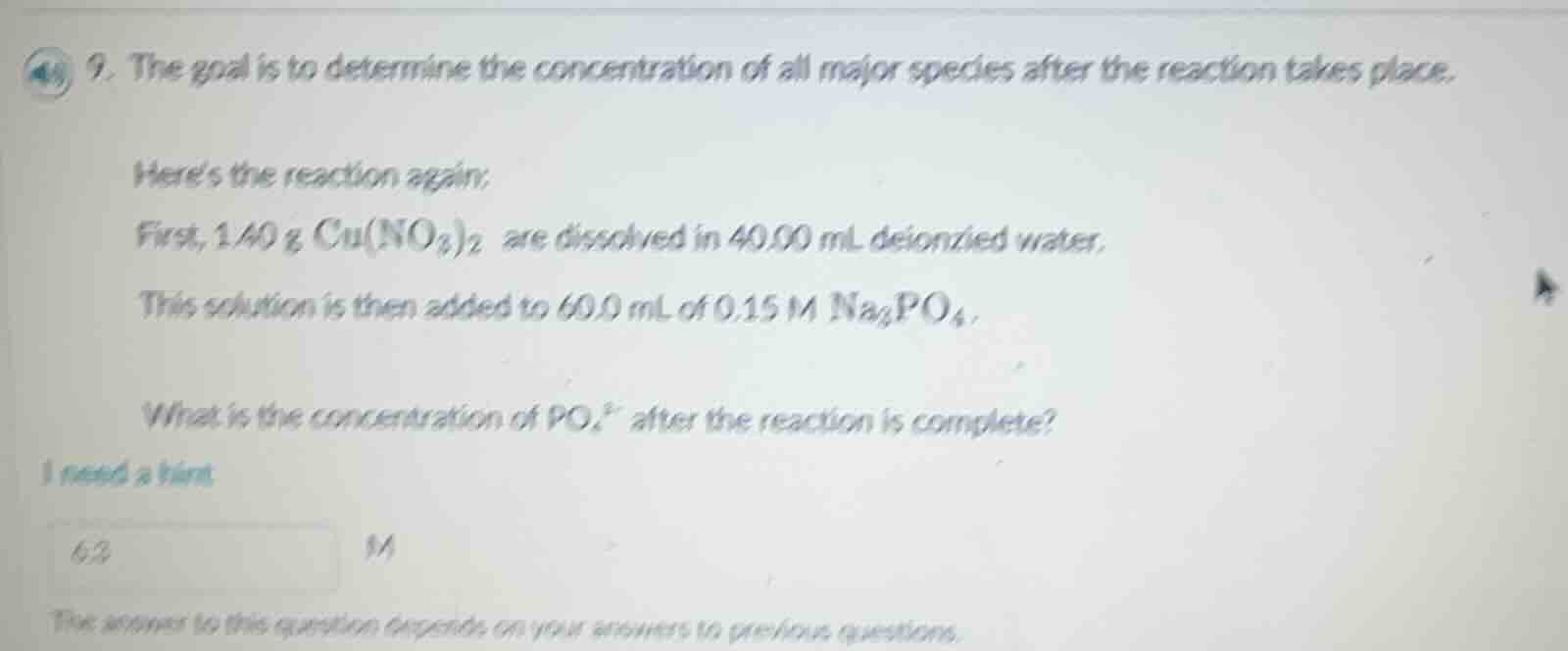
9. the goal is to determine the concentration of all major species after the reaction takes place.\n\nheres the reaction again:\nfirst, $1.40\\text{ g } cu(no_{3})_{2}$ are dissolved in $40.00\\text{ ml}$ deionized water.\nthis solution is then added to $60.0\\text{ ml}$ of $0.15\\text{ m } na_{3}po_{4}$.\n\nwhat is the concentration of $po_{4}^{3-}$ after the reaction is complete?
Answer
Explanation:
Step1: Calculate moles of copper(II) nitrate
$$n_{Cu(NO_3)_2} = \frac{1.40\text{ g}}{187.56\text{ g/mol}} \approx 0.007464\text{ mol}$$
Step2: Calculate initial moles of phosphate
$$n_{PO_4^{3-}} = 0.0600\text{ L} \times 0.15\text{ M} = 0.00900\text{ mol}$$
Step3: Identify the balanced precipitation reaction
$$3Cu^{2+}(aq) + 2PO_4^{3-}(aq) \rightarrow Cu_3(PO_4)_2(s)$$
Step4: Determine the limiting reactant
$$n_{Cu^{2+}} \text{ requires } \frac{2}{3} \times 0.007464 = 0.004976\text{ mol } PO_4^{3-}$$
Step5: Calculate remaining moles of phosphate
$$n_{excess} = 0.00900 - 0.004976 = 0.004024\text{ mol}$$
Step6: Calculate final concentration in total volume
$$[PO_4^{3-}] = \frac{0.004024\text{ mol}}{0.0400\text{ L} + 0.0600\text{ L}} = 0.04024\text{ M}$$
Answer:
0.040 M