which group of elements has the most similar set of physical and chemical properties? / ¿qué grupo de…
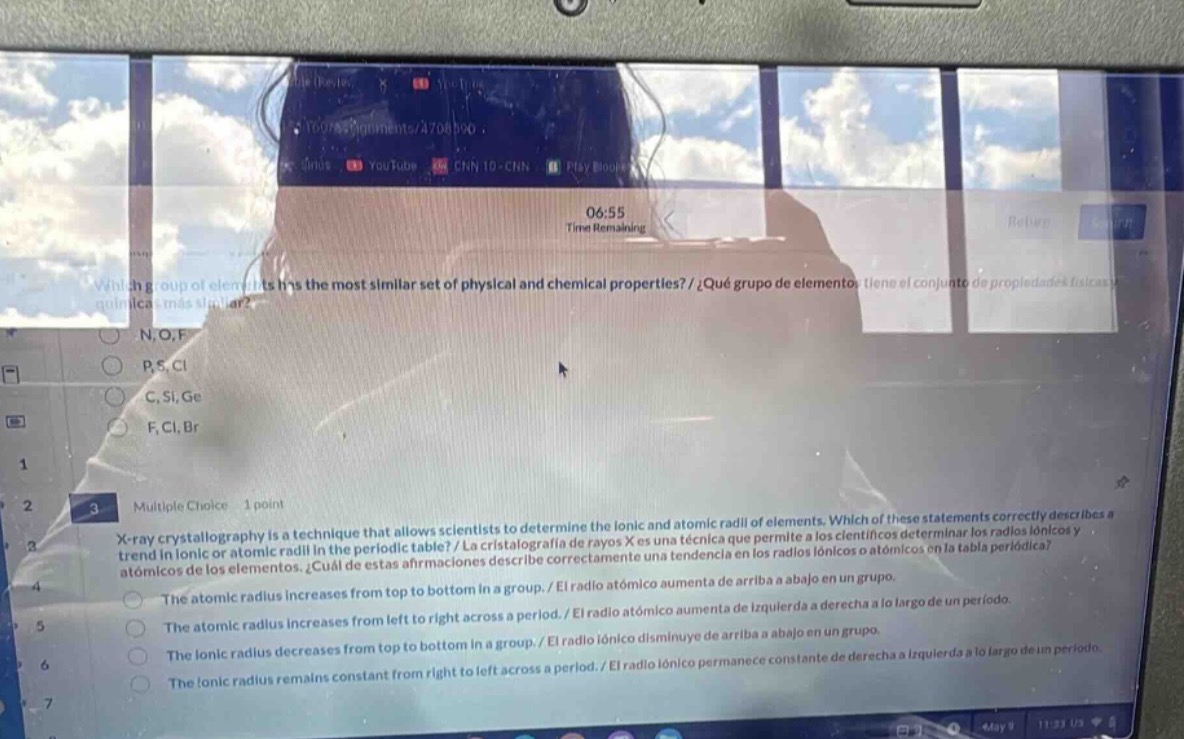
which group of elements has the most similar set of physical and chemical properties? / ¿qué grupo de elementos tiene el conjunto de propiedades físicas y químicas más similar?\nn, o, f\np, s, cl\nc, si, ge\nf, cl, br\nmultiple choice 1 point\nx - ray crystallography is a technique that allows scientists to determine the ionic and atomic radii of elements. which of these statements correctly describes a trend in ionic or atomic radii in the periodic table? / la cristalografía de rayos x es una técnica que permite a los científicos determinar los radios iónicos y atómicos de los elementos. ¿cuál de estas afirmaciones describe correctamente una tendencia en los radios iónicos o atómicos en la tabla periódica?\nthe atomic radius increases from top to bottom in a group. / el radio atómico aumenta de arriba abajo en un grupo.\nthe atomic radius increases from left to right across a period. / el radio atómico aumenta de izquierda a derecha a lo largo de un período.\nthe ionic radius decreases from top to bottom in a group. / el radio iónico disminuye de arriba abajo en un grupo.\nthe ionic radius remains constant from right to left across a period. / el radio iónico permanece constante de derecha a izquierda a lo largo de un período.
Answer
- First question:
- Brief Explanations: Elements in the same group of the periodic - table have similar physical and chemical properties. Fluorine (F), chlorine (Cl), and bromine (Br) are all in Group 17 (halogens). Nitrogen (N), oxygen (O), and fluorine (F) are in different groups and have different valences and properties. Phosphorus (P), sulfur (S), and chlorine (Cl) are also in different groups. Carbon (C), silicon (Si), and germanium (Ge) are in Group 14, but their properties are not as similar in terms of reactivity as the halogens. Halogens have similar outer - electron configurations, which leads to similar chemical behavior.
- Answer: D. F, Cl, Br
- Second question:
- Brief Explanations: In the periodic table, the atomic radius increases from top to bottom in a group because as you move down a group, the number of electron shells increases. The atomic radius decreases from left to right across a period due to the increasing effective nuclear charge. The ionic radius generally increases from top to bottom in a group for the same reason as atomic radius (more electron shells). The ionic radius does not remain constant from right to left across a period.
- Answer: A. The atomic radius increases from top to bottom in a group.