1. what happens to the ph of drain cleaner when you add water? why do you think this happens? \nhypothesize…
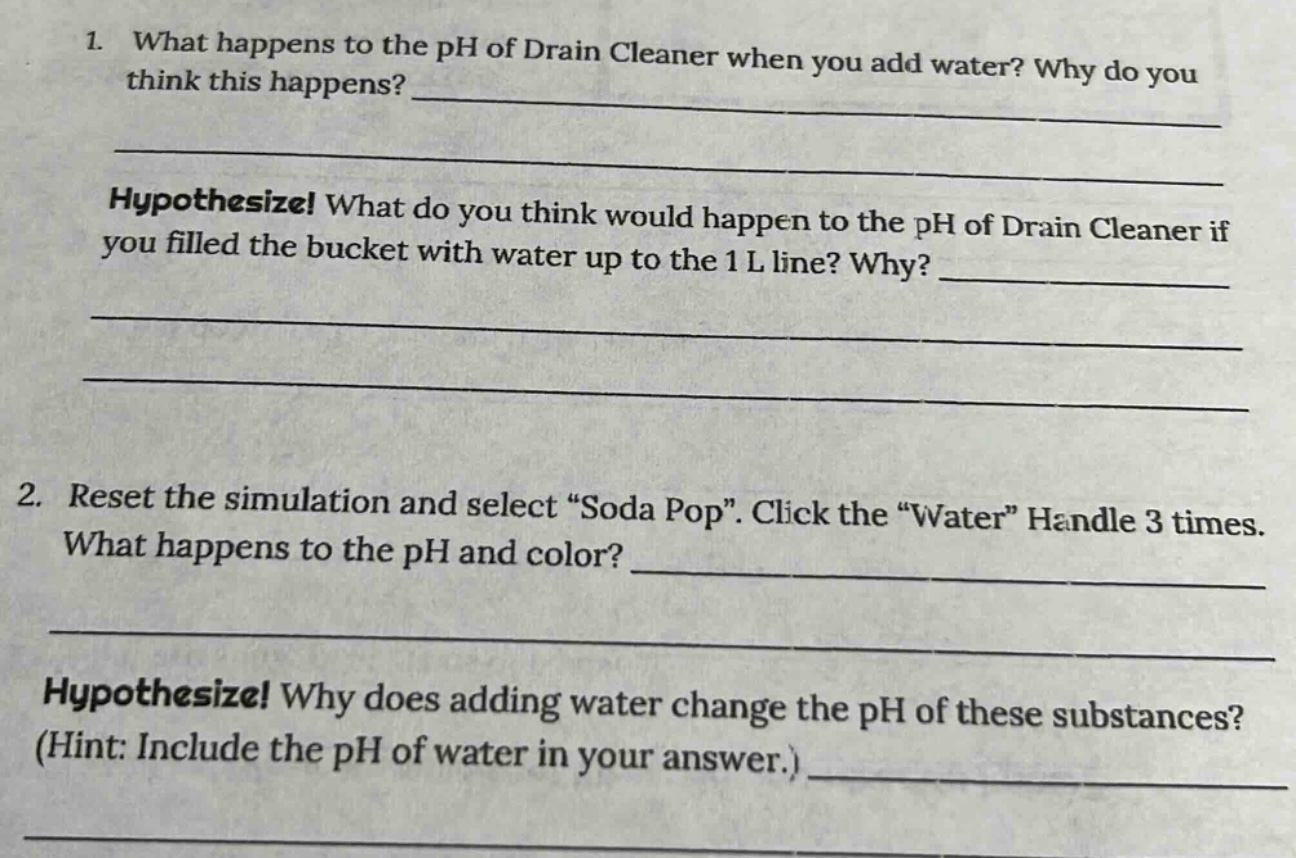
1. what happens to the ph of drain cleaner when you add water? why do you think this happens? \nhypothesize! what do you think would happen to the ph of drain cleaner if you filled the bucket with water up to the 1 l line? why? \n\n2. reset the simulation and select “soda pop”. click the “water” handle 3 times. what happens to the ph and color? \nhypothesize! why does adding water change the ph of these substances? (hint: include the ph of water in your answer.)
Answer
Brief Explanations:
- Drain cleaner is usually a strong - base. When water is added, it dilutes the concentration of hydroxide ions ($OH^-$). Since pH is related to the concentration of hydrogen ions ($H^+$) and hydroxide ions in an inverse - logarithmic relationship ($pH = 14+log[OH^-]$ for basic solutions), the pH decreases as the base is diluted. If the bucket is filled with water up to the 1 L line, the pH will decrease further because of greater dilution.
- Soda pop is acidic due to carbonic acid and other acidic components. Adding water dilutes the concentration of hydrogen ions ($H^+$). As $pH=-log[H^+]$, the pH increases. The color may also change depending on the pH - indicator used in the simulation. Adding water changes the pH of substances because water has a neutral pH of 7. When added to an acidic or basic substance, it changes the relative concentration of $H^+$ or $OH^-$ ions in the solution.
Answer:
- The pH of drain cleaner decreases when water is added because dilution reduces the concentration of hydroxide ions. If the bucket is filled with water up to the 1 L line, the pH will decrease further due to more dilution.
- The pH of soda pop increases and the color may change (depending on the pH - indicator). Adding water changes the pH of substances because water is neutral (pH = 7) and dilutes the concentration of $H^+$ or $OH^-$ ions in the acidic or basic substances.