hcl + naoh → nacl + h₂o\n25.0 ml of 1.00 m hcl is added to\n75.0 ml of 1.00 m naoh. the\nresulting…
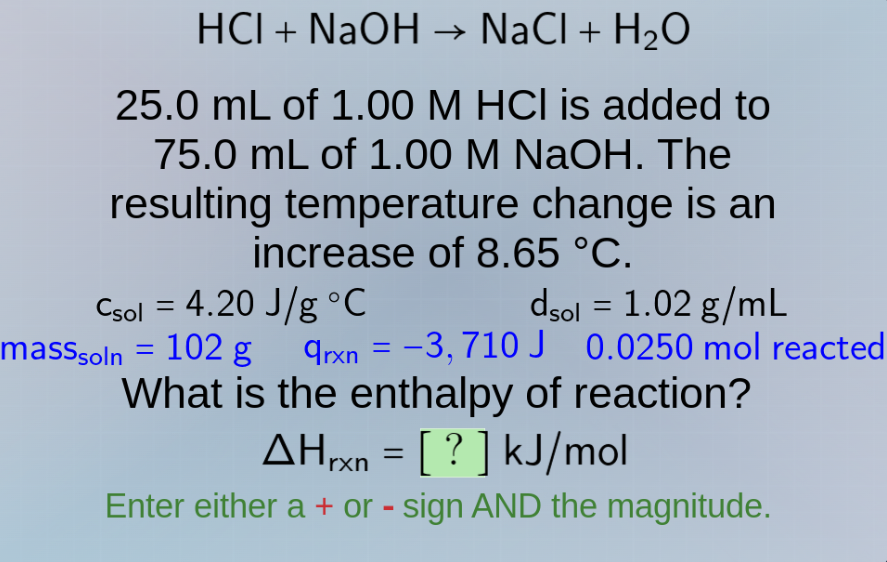
hcl + naoh → nacl + h₂o\n25.0 ml of 1.00 m hcl is added to\n75.0 ml of 1.00 m naoh. the\nresulting temperature change is an\nincrease of 8.65 °c.\ncsol = 4.20 j/g °c dsol = 1.02 g/ml\nmasssoln = 102 g qrxn = −3,710 j 0.0250 mol reacted\nwhat is the enthalpy of reaction?\nδhrxn = ? kj/mol\nenter either a + or - sign and the magnitude.
Answer
Explanation:
Step1: Recall enthalpy formula
The enthalpy of reaction ($\Delta H_{rxn}$) is given by the heat of the reaction ($q_{rxn}$) divided by the moles of reactant that reacted ($n$), i.e., $\Delta H_{rxn}=\frac{q_{rxn}}{n}$.
Step2: Substitute values
We know $q_{rxn} = - 3710\ J=-3.710\ kJ$ (since $1\ kJ = 1000\ J$) and $n = 0.0250\ mol$. So, $\Delta H_{rxn}=\frac{-3.710\ kJ}{0.0250\ mol}$.
Step3: Calculate the value
$\frac{-3.710}{0.0250}=-148.4\ kJ/mol$. Since the reaction is exothermic (temperature increases), the sign is negative.
Answer:
-148 kJ/mol (or -148.4 kJ/mol depending on precision)