the highlighted bond is polar and the more negative atom is \nthe highlighted bond is nonpolar.\nthe…
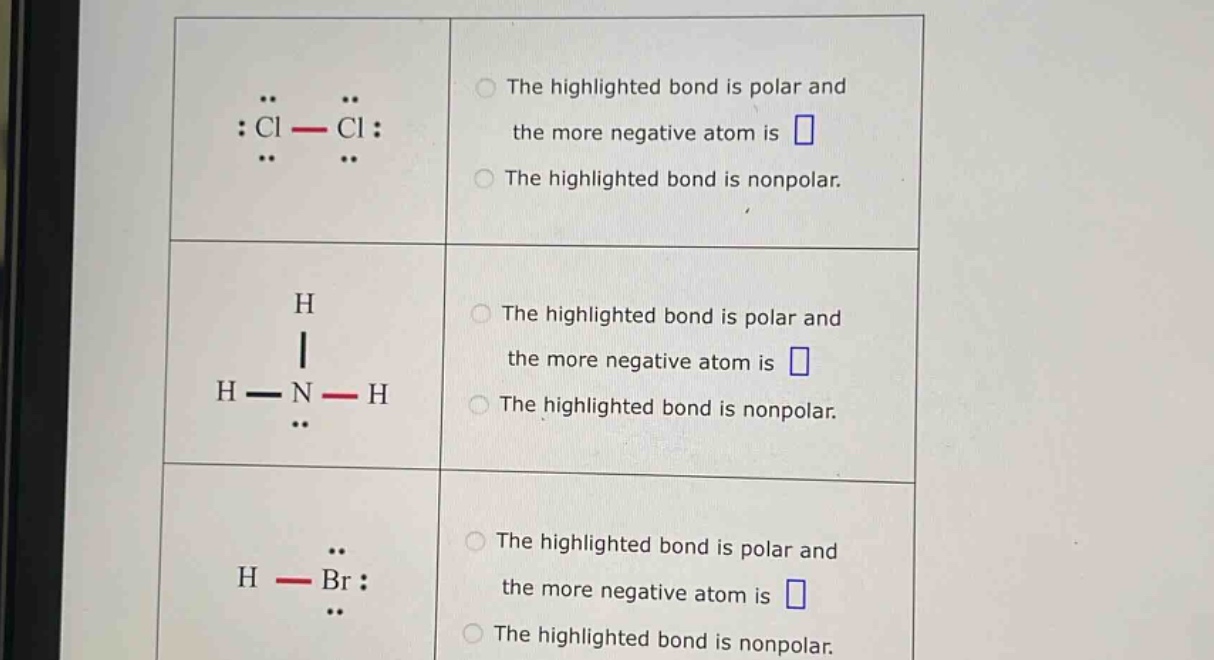
the highlighted bond is polar and the more negative atom is \nthe highlighted bond is nonpolar.\nthe highlighted bond is polar and the more negative atom is \nthe highlighted bond is nonpolar.\nthe highlighted bond is polar and the more negative atom is \nthe highlighted bond is nonpolar.
Answer
Explanation:
Step1: Recall electronegativity concept
Electronegativity determines bond polarity. If two atoms have the same electronegativity, the bond is non - polar. If different, the more electronegative atom is more negative.
Step2: Analyze Cl - Cl bond
Chlorine atoms in Cl - Cl have the same electronegativity. So, the bond is non - polar.
Step3: Analyze N - H bond
Nitrogen (N) has an electronegativity of 3.04 and hydrogen (H) has 2.20. N is more electronegative. So, the N - H bond is polar and the more negative atom is N.
Step4: Analyze H - Br bond
Bromine (Br) has an electronegativity of 2.96 and hydrogen (H) has 2.20. Br is more electronegative. So, the H - Br bond is polar and the more negative atom is Br.
Answer:
- The highlighted bond is nonpolar.
- The highlighted bond is polar and the more negative atom is N.
- The highlighted bond is polar and the more negative atom is Br.