honors chemistry final exam\ntwo buffers are represented in the diagram.\nbuffer x: 0.10 m nh₃(aq) + 0.10 m…
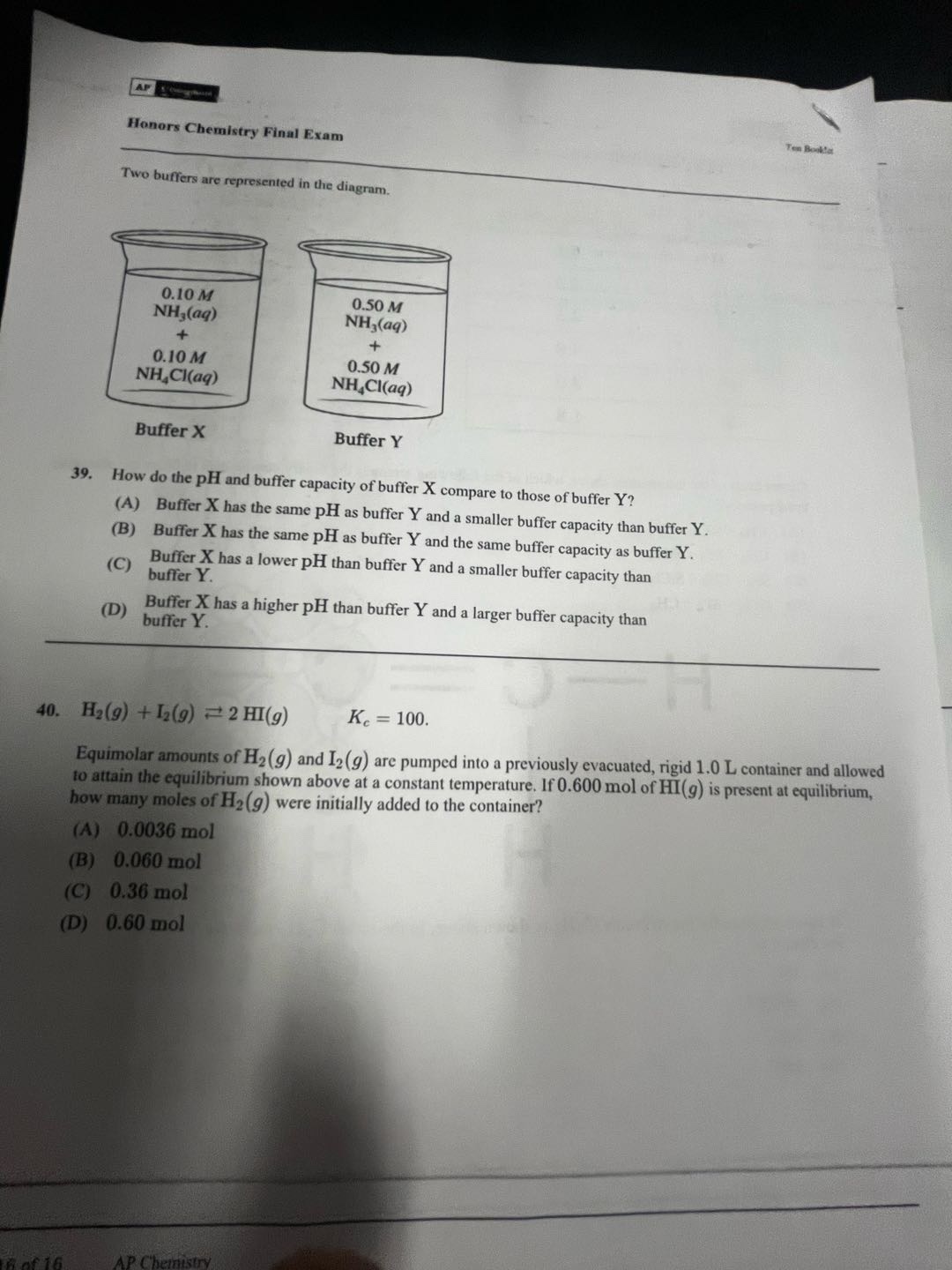
honors chemistry final exam\ntwo buffers are represented in the diagram.\nbuffer x: 0.10 m nh₃(aq) + 0.10 m nh₄cl(aq)\nbuffer y: 0.50 m nh₃(aq) + 0.50 m nh₄cl(aq)\n39. how do the ph and buffer capacity of buffer x compare to those of buffer y?\n(a) buffer x has the same ph as buffer y and a smaller buffer capacity than buffer y.\n(b) buffer x has the same ph as buffer y and the same buffer capacity as buffer y.\n(c) buffer x has a lower ph than buffer y and a smaller buffer capacity than buffer y.\n(d) buffer x has a higher ph than buffer y and a larger buffer capacity than buffer y.\n40. h₂(g) + i₂(g) ⇌ 2 hi(g) kₑ = 100.\nequimolar amounts of h₂(g) and i₂(g) are pumped into a previously evacuated, rigid 1.0 l container and allowed to attain the equilibrium shown above at a constant temperature. if 0.600 mol of hi(g) is present at equilibrium, how many moles of h₂(g) were initially added to the container?\n(a) 0.0036 mol\n(b) 0.060 mol\n(c) 0.36 mol\n(d) 0.60 mol
Answer
39.
Explanation:
Step1: Recall buffer - pH formula
For a buffer of a weak - base and its conjugate acid ($NH_3$ and $NH_4^+$), the Henderson - Hasselbalch equation is $pOH=pK_b+\log\frac{[NH_4^+]}{[NH_3]}$. For buffer X, $\frac{[NH_4^+]}{[NH_3]}=\frac{0.10\ M}{0.10\ M} = 1$, so $pOH=pK_b$. For buffer Y, $\frac{[NH_4^+]}{[NH_3]}=\frac{0.50\ M}{0.50\ M}=1$, so $pOH = pK_b$. Since $pH + pOH=14$, both buffers have the same pH.
Step2: Recall buffer - capacity concept
Buffer capacity ($\beta$) is proportional to the concentration of the buffer components. Higher concentrations of the weak - base and its conjugate acid mean higher buffer capacity. Buffer Y has higher concentrations of $NH_3$ and $NH_4^+$ than buffer X, so buffer Y has a higher buffer capacity.
Answer:
B. Buffer X has the same pH as buffer Y and a smaller buffer capacity than buffer Y.
40.
Explanation:
Step1: Set up the ICE table
Let the initial moles of $H_2$ and $I_2$ be $x$ moles each (since they are equimolar). The volume of the container is $V = 1.0\ L$.
| $H_2(g)$ | $I_2(g)$ | $2HI(g)$ | |
|---|---|---|---|
| Initial (mol/L) | $x$ | $x$ | 0 |
| Change (mol/L) | $-y$ | $-y$ | $+ 2y$ |
| Equilibrium (mol/L) | $x - y$ | $x - y$ | $2y$ |
| We know that at equilibrium, $2y=0.600\ mol/L$ (since $n = CV$ and $V = 1.0\ L$), so $y = 0.300\ mol/L$. |
Step2: Write the equilibrium - constant expression
The equilibrium - constant expression for the reaction $H_2(g)+I_2(g)\rightleftharpoons2HI(g)$ is $K_c=\frac{[HI]^2}{[H_2][I_2]}$. Substituting the equilibrium concentrations, $K_c = 100=\frac{(0.600)^2}{(x - 0.300)^2}$.
Step3: Solve for $x$
Taking the square - root of both sides of the equation $100=\frac{(0.600)^2}{(x - 0.300)^2}$, we get $10=\frac{0.600}{x - 0.300}$. Cross - multiplying gives $10(x - 0.300)=0.600$. Expanding, $10x-3.00 = 0.600$. Then $10x=3.600$, and $x = 0.36\ mol$.
Answer:
C. $0.36\ mol$