a. what is the hybridization of the central atom in sf₄? hybridization = what are the approximate bond…
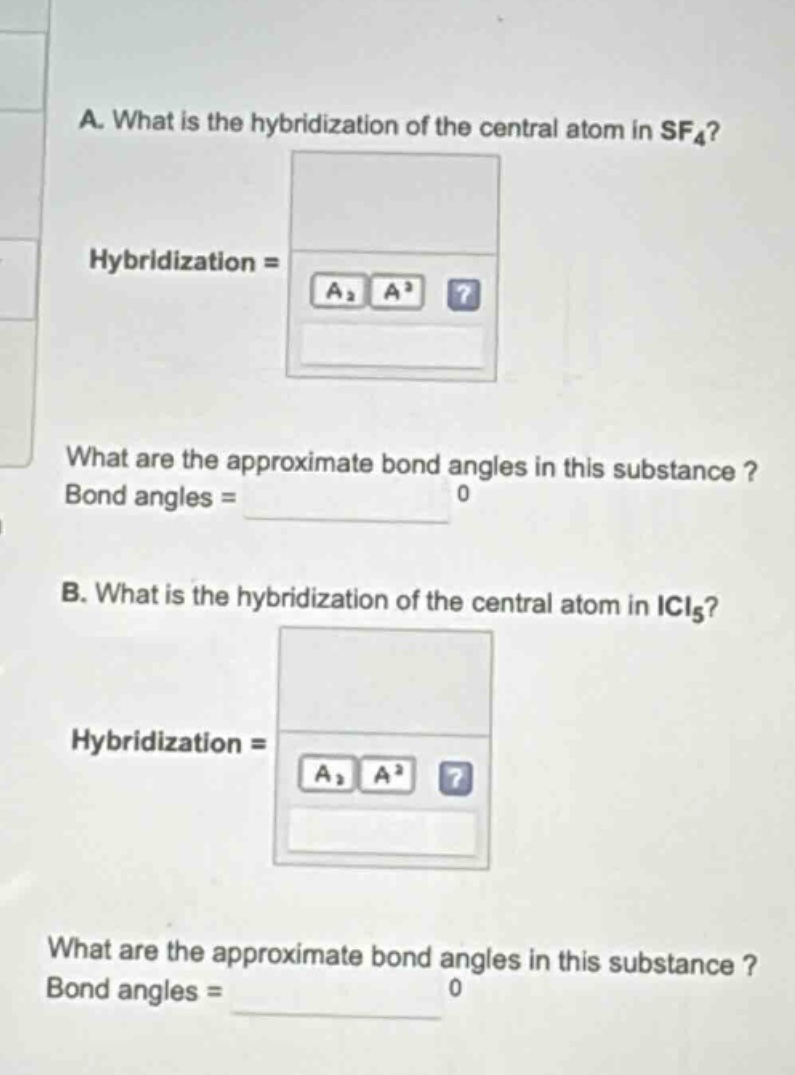
a. what is the hybridization of the central atom in sf₄? hybridization = what are the approximate bond angles in this substance? bond angles = 0 b. what is the hybridization of the central atom in icl₅? hybridization = what are the approximate bond angles in this substance? bond angles = 0
Answer
Explanation:
Step1: Determine valence electrons for SF₄
S has 6 valence electrons; 4 F atoms contribute 4 electrons. Total: 10 electrons (5 electron pairs).
Step2: Calculate electron pair geometry
4 bonding pairs + 1 lone pair = trigonal bipyramidal geometry. Hybridization: sp³d.
Step3: Bond angles in SF₄
Lone pair causes repulsion; bond angles are approximately 102° (axial-equatorial) and 173° (axial-axial).
Step4: Determine valence electrons for ICl₅
I has 7 valence electrons; 5 Cl atoms contribute 5 electrons. Total: 12 electrons (6 electron pairs).
Step5: Calculate electron pair geometry
5 bonding pairs + 1 lone pair (wait, no—ICl₅ has 5 bonding pairs, central I has 7+5=12 electrons: 6 pairs, all bonding? Correct: 5 bonding, 1 lone pair? No, ICl₅ has 5 bond pairs and 1 lone pair? Wait no: I in ICl₅: valence electrons 7, 5 Cl each give 1, total 12 electrons = 6 pairs. 5 bonding pairs, 1 lone pair? No, ICl₅ structure is square pyramidal: 5 bonding, 1 lone pair. Wait no, actually ICl₅ has 5 bond pairs and 1 lone pair? No, central I in ICl₅: formal charge 0, so 7 valence - 5 bonds - 2 lone electrons = 0, so 1 lone pair. So electron geometry octahedral, hybridization sp³d². Bond angles: square pyramidal, so 90°.
Answer:
A. Hybridization = sp³d
Bond angles = approximately 102° and 173°
B. Hybridization = sp³d²
Bond angles = approximately 90°