why can a hydrogen atom form a covalent bond without fulfilling the octet rule?\nhydrogens valence shell can…
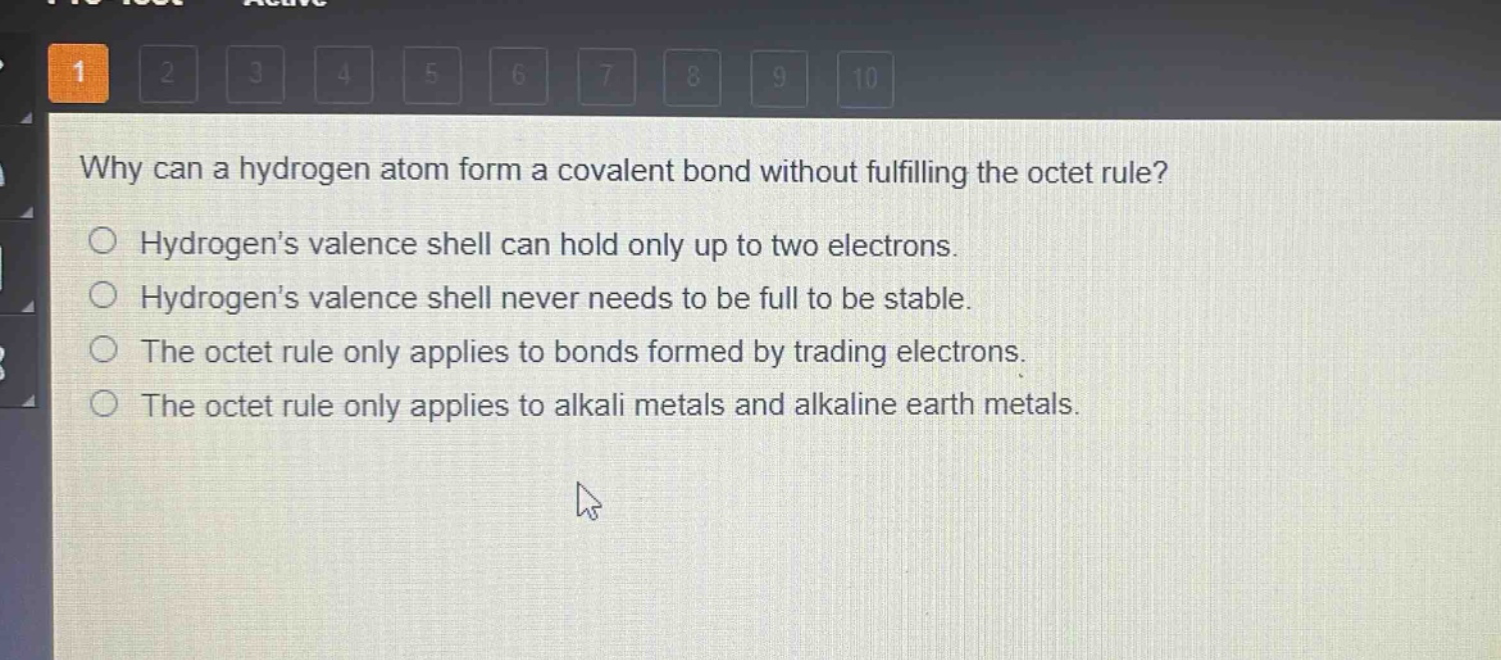
why can a hydrogen atom form a covalent bond without fulfilling the octet rule?\nhydrogens valence shell can hold only up to two electrons.\nhydrogens valence shell never needs to be full to be stable.\nthe octet rule only applies to bonds formed by trading electrons.\nthe octet rule only applies to alkali metals and alkaline earth metals.
Answer
Brief Explanations:
The octet rule states that atoms tend to gain, lose, or share electrons to have eight electrons in their valence shell for stability. However, hydrogen has only a 1s - orbital in its valence shell, which can hold a maximum of 2 electrons. So, it forms covalent bonds to achieve a stable 2 - electron configuration (duet rule).
Answer:
Hydrogen's valence shell can hold only up to two electrons.