hydrogen gas combines with oxygen gas to produce dihydrogen monoxide. 1 point how many moles of dihydrogen…
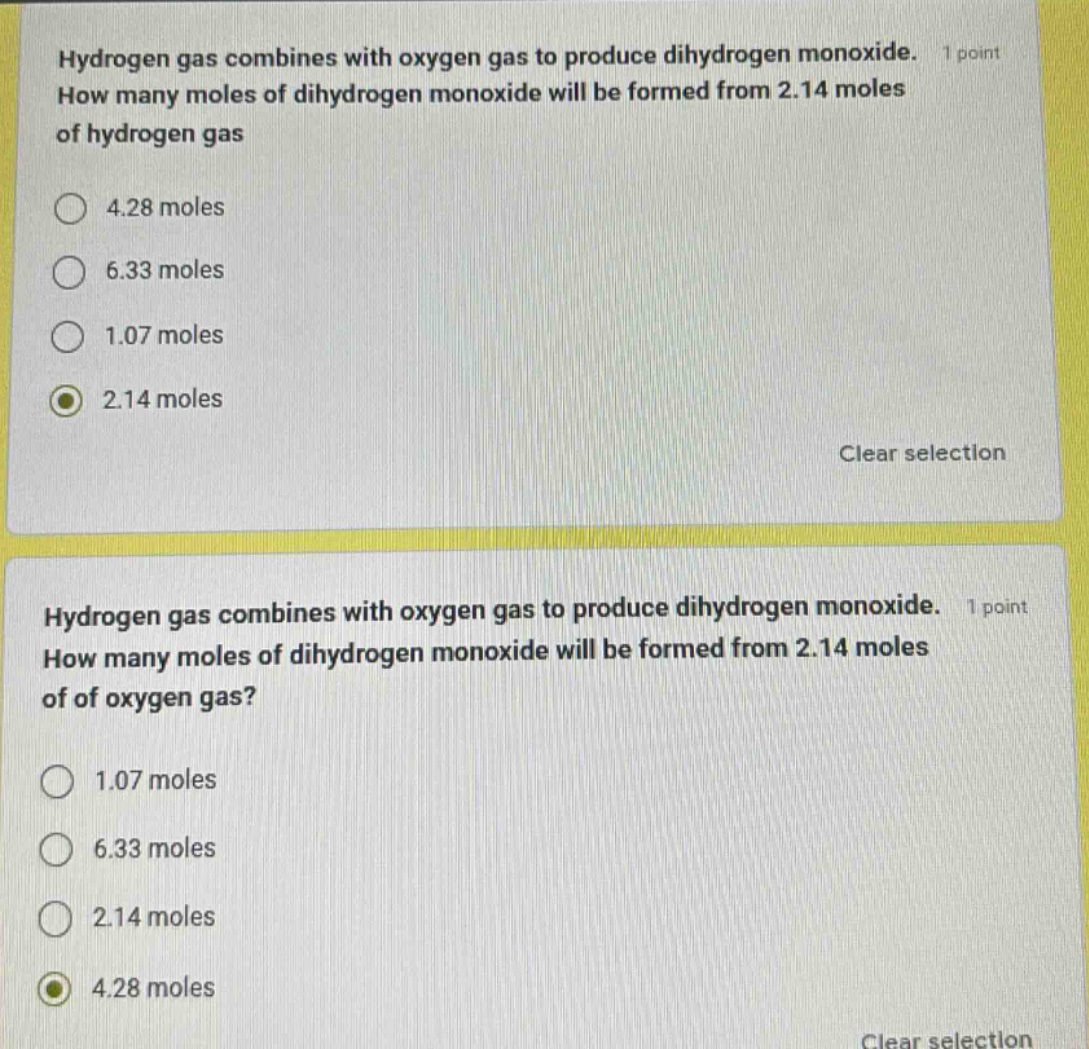
hydrogen gas combines with oxygen gas to produce dihydrogen monoxide. 1 point how many moles of dihydrogen monoxide will be formed from 2.14 moles of hydrogen gas\n4.28 moles\n6.33 moles\n1.07 moles\n2.14 moles\nclear selection\nhydrogen gas combines with oxygen gas to produce dihydrogen monoxide. 1 point how many moles of dihydrogen monoxide will be formed from 2.14 moles of of oxygen gas?\n1.07 moles\n6.33 moles\n2.14 moles\n4.28 moles\nclear selection
Answer
Explanation:
Step1: Write the balanced chemical equation
$2H_2 + O_2=2H_2O$ (dihydrogen monoxide is water). The mole - ratio of $H_2$ to $H_2O$ is 1:1, and the mole - ratio of $O_2$ to $H_2O$ is 1:2.
Step2: Calculate moles of $H_2O$ from $H_2$
Given 2.14 moles of $H_2$. Since the mole - ratio of $H_2$ to $H_2O$ is 1:1, the moles of $H_2O$ formed is also 2.14 moles.
Step3: Calculate moles of $H_2O$ from $O_2$
Given 2.14 moles of $O_2$. Since the mole - ratio of $O_2$ to $H_2O$ is 1:2, the moles of $H_2O$ formed is $2.14\times2 = 4.28$ moles.
Answer:
For the first question: 2.14 moles For the second question: 4.28 moles