1. hydrogen peroxide decomposition:\nthe decomposition of hydrogen peroxide can be represented by the…
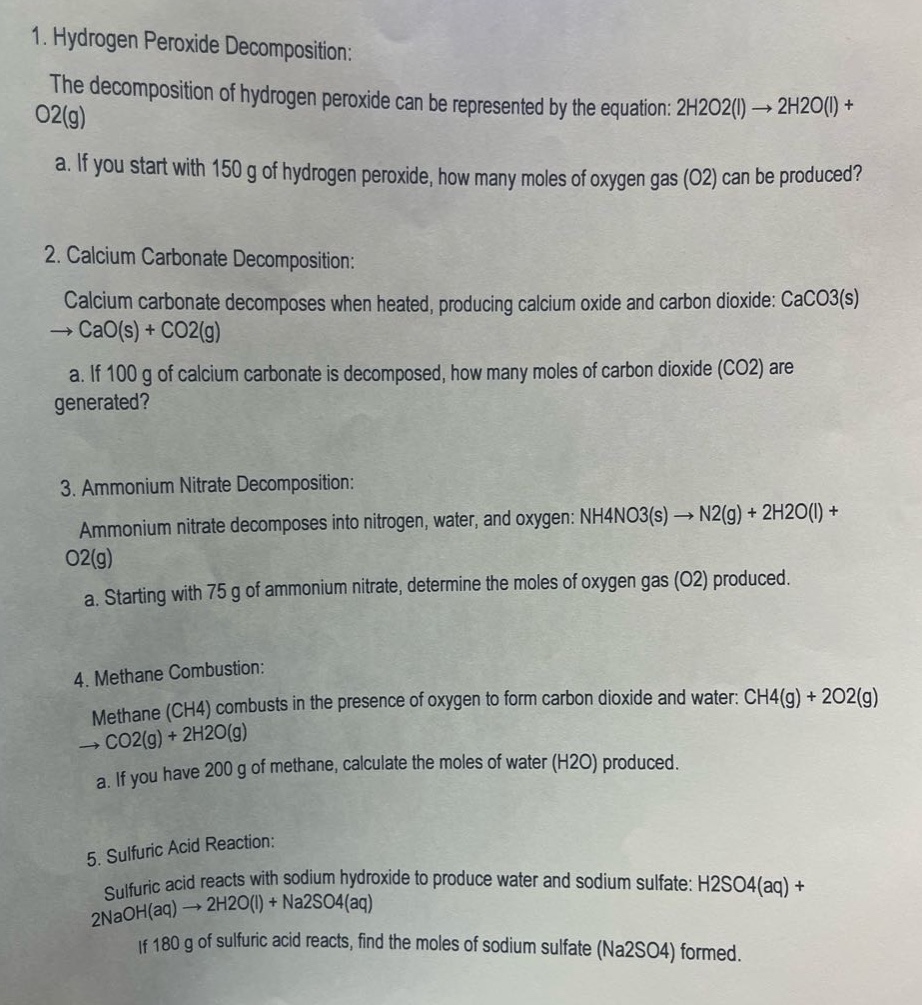
1. hydrogen peroxide decomposition:\nthe decomposition of hydrogen peroxide can be represented by the equation: 2h2o2(l) → 2h2o(l) + o2(g)\n\ta. if you start with 150 g of hydrogen peroxide, how many moles of oxygen gas (o2) can be produced?\n\n2. calcium carbonate decomposition:\ncalcium carbonate decomposes when heated, producing calcium oxide and carbon dioxide: caco3(s) → cao(s) + co2(g)\n\ta. if 100 g of calcium carbonate is decomposed, how many moles of carbon dioxide (co2) are generated?\n\n3. ammonium nitrate decomposition:\nammonium nitrate decomposes into nitrogen, water, and oxygen: nh4no3(s) → n2(g) + 2h2o(l) + o2(g)\n\ta. starting with 75 g of ammonium nitrate, determine the moles of oxygen gas (o2) produced.\n\n4. methane combustion:\nmethane (ch4) combusts in the presence of oxygen to form carbon dioxide and water: ch4(g) + 2o2(g) → co2(g) + 2h2o(g)\n\ta. if you have 200 g of methane, calculate the moles of water (h2o) produced.\n\n5. sulfuric acid reaction:\nsulfuric acid reacts with sodium hydroxide to produce water and sodium sulfate: h2so4(aq) + 2naoh(aq) → 2h2o(l) + na2so4(aq)\n\tif 180 g of sulfuric acid reacts, find the moles of sodium sulfate (na2so4) formed.
Answer
1. Hydrogen Peroxide Decomposition
Explanation:
Step1: Calculate moles of hydrogen peroxide
The molar - mass of $H_2O_2$ is $M_{H_2O_2}=(2\times1 + 2\times16)\text{ g/mol}=34\text{ g/mol}$. The number of moles of $H_2O_2$, $n_{H_2O_2}=\frac{m_{H_2O_2}}{M_{H_2O_2}}=\frac{150\text{ g}}{34\text{ g/mol}}\approx4.41\text{ mol}$.
Step2: Use stoichiometry
From the balanced equation $2H_2O_2(l)\rightarrow2H_2O(l)+O_2(g)$, the mole - ratio of $H_2O_2$ to $O_2$ is $2:1$. So the number of moles of $O_2$, $n_{O_2}=\frac{1}{2}n_{H_2O_2}=\frac{1}{2}\times4.41\text{ mol}\approx2.21\text{ mol}$.
Answer:
$2.21\text{ mol}$
2. Calcium Carbonate Decomposition
Explanation:
Step1: Calculate moles of calcium carbonate
The molar - mass of $CaCO_3$ is $M_{CaCO_3}=(40 + 12+3\times16)\text{ g/mol}=100\text{ g/mol}$. The number of moles of $CaCO_3$, $n_{CaCO_3}=\frac{m_{CaCO_3}}{M_{CaCO_3}}=\frac{100\text{ g}}{100\text{ g/mol}} = 1\text{ mol}$.
Step2: Use stoichiometry
From the balanced equation $CaCO_3(s)\rightarrow CaO(s)+CO_2(g)$, the mole - ratio of $CaCO_3$ to $CO_2$ is $1:1$. So the number of moles of $CO_2$, $n_{CO_2}=n_{CaCO_3}=1\text{ mol}$.
Answer:
$1\text{ mol}$
3. Ammonium Nitrate Decomposition
Explanation:
Step1: Calculate moles of ammonium nitrate
The molar - mass of $NH_4NO_3$ is $M_{NH_4NO_3}=(2\times14 + 4\times1+3\times16)\text{ g/mol}=80\text{ g/mol}$. The number of moles of $NH_4NO_3$, $n_{NH_4NO_3}=\frac{m_{NH_4NO_3}}{M_{NH_4NO_3}}=\frac{75\text{ g}}{80\text{ g/mol}} = 0.9375\text{ mol}$.
Step2: Use stoichiometry
From the balanced equation $NH_4NO_3(s)\rightarrow N_2(g)+2H_2O(l)+O_2(g)$, the mole - ratio of $NH_4NO_3$ to $O_2$ is $1:1$. So the number of moles of $O_2$, $n_{O_2}=n_{NH_4NO_3}=0.9375\text{ mol}$.
Answer:
$0.9375\text{ mol}$
4. Methane Combustion
Explanation:
Step1: Calculate moles of methane
The molar - mass of $CH_4$ is $M_{CH_4}=(12 + 4\times1)\text{ g/mol}=16\text{ g/mol}$. The number of moles of $CH_4$, $n_{CH_4}=\frac{m_{CH_4}}{M_{CH_4}}=\frac{200\text{ g}}{16\text{ g/mol}} = 12.5\text{ mol}$.
Step2: Use stoichiometry
From the balanced equation $CH_4(g)+2O_2(g)\rightarrow CO_2(g)+2H_2O(g)$, the mole - ratio of $CH_4$ to $H_2O$ is $1:2$. So the number of moles of $H_2O$, $n_{H_2O}=2n_{CH_4}=2\times12.5\text{ mol}=25\text{ mol}$.
Answer:
$25\text{ mol}$
5. Sulfuric Acid Reaction
Explanation:
Step1: Calculate moles of sulfuric acid
The molar - mass of $H_2SO_4$ is $M_{H_2SO_4}=(2\times1+32 + 4\times16)\text{ g/mol}=98\text{ g/mol}$. The number of moles of $H_2SO_4$, $n_{H_2SO_4}=\frac{m_{H_2SO_4}}{M_{H_2SO_4}}=\frac{180\text{ g}}{98\text{ g/mol}}\approx1.84\text{ mol}$.
Step2: Use stoichiometry
From the balanced equation $H_2SO_4(aq)+2NaOH(aq)\rightarrow2H_2O(l)+Na_2SO_4(aq)$, the mole - ratio of $H_2SO_4$ to $Na_2SO_4$ is $1:1$. So the number of moles of $Na_2SO_4$, $n_{Na_2SO_4}=n_{H_2SO_4}\approx1.84\text{ mol}$.
Answer:
$1.84\text{ mol}$