hypothetically, if you could make an aqueous solution of both nabr and agf at a ph of 7, what is produced at…
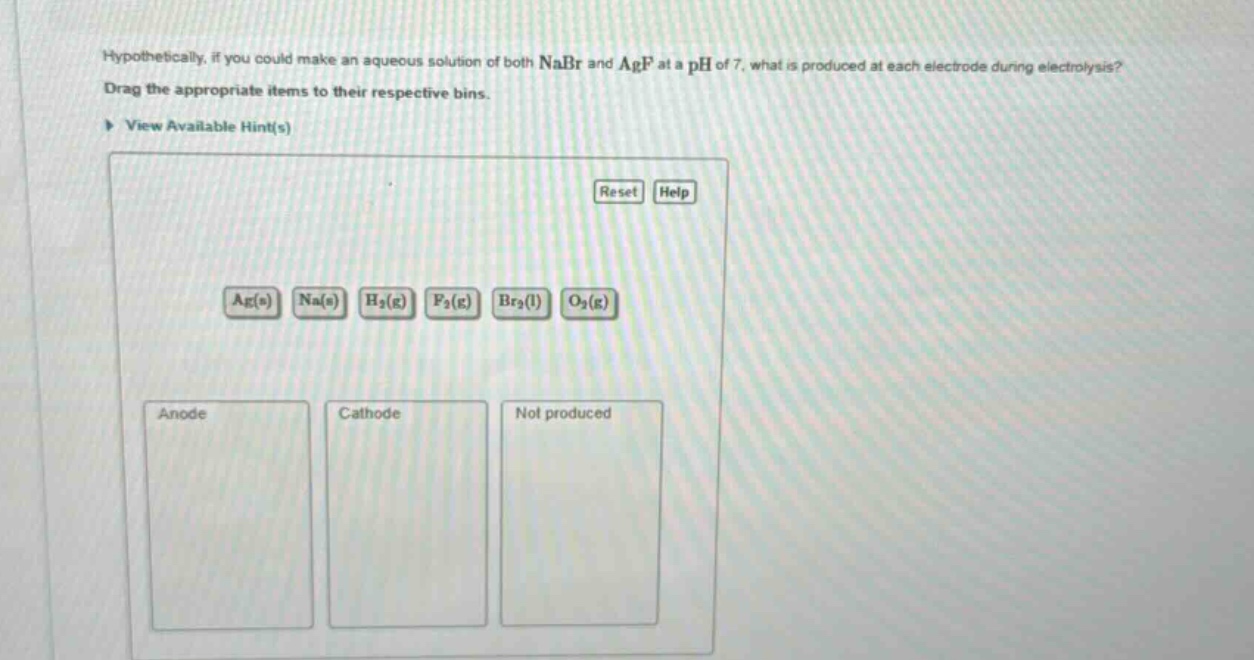
hypothetically, if you could make an aqueous solution of both nabr and agf at a ph of 7, what is produced at each electrode during electrolysis? drag the appropriate items to their respective bins. view available hint(s) reset help ag(s) na(s) h₂(g) f₂(g) br₂(l) o₂(g) anode cathode not produced
Answer
Explanation:
Step1: Analyze oxidation at anode
In an aqueous solution of NaBr and AgF, bromide ions ($Br^-$) are more easily oxidized than water. The oxidation - half reaction for $Br^-$ is $2Br^-(aq)\rightarrow Br_2(l)+2e^-$. So, $Br_2(l)$ is produced at the anode.
Step2: Analyze reduction at cathode
Silver ions ($Ag^+$) have a higher reduction potential than hydrogen ions ($H^+$) and sodium ions ($Na^+$). The reduction - half reaction for $Ag^+$ is $Ag^+(aq) + e^-\rightarrow Ag(s)$. So, $Ag(s)$ is produced at the cathode.
Step3: Determine non - produced species
Sodium ($Na$) is not produced because $Na^+$ has a very low reduction potential compared to $Ag^+$ and water. Fluoride ions ($F^-$) are very difficult to oxidize, so $F_2(g)$ is not produced. Also, since $Ag^+$ is preferentially reduced at the cathode, $H_2(g)$ is not produced. And since $Br^-$ is preferentially oxidized at the anode, $O_2(g)$ is not produced.
Answer:
Anode: $Br_2(l)$ Cathode: $Ag(s)$ Not produced: $Na(s), H_2(g), F_2(g), O_2(g)$