identify the dissociation equation for the dissociation of the weak acid hydrofluoric acid (hf) in water…
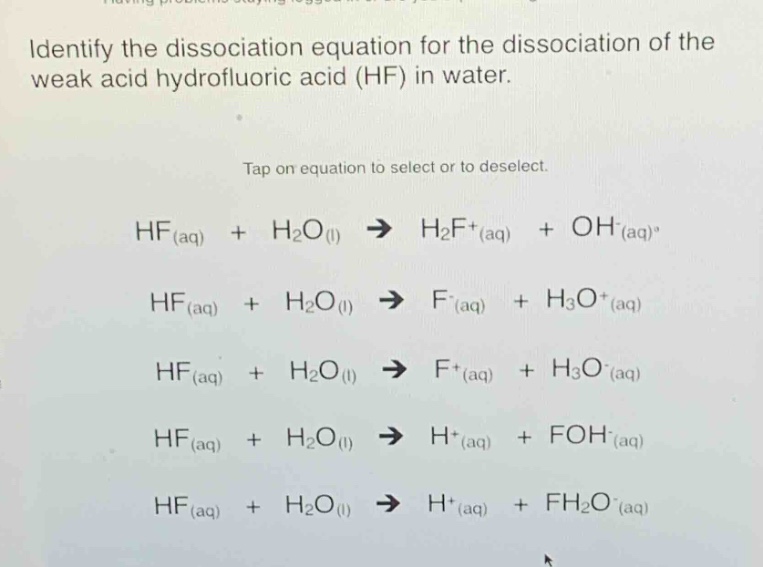
identify the dissociation equation for the dissociation of the weak acid hydrofluoric acid (hf) in water. tap on equation to select or to deselect. hf(aq) + h2o(l) → h2f+(aq) + oh-(aq) hf(aq) + h2o(l) → f-(aq) + h3o+(aq) hf(aq) + h2o(l) → f+(aq) + h3o-(aq) hf(aq) + h2o(l) → h+(aq) + foh-(aq) hf(aq) + h2o(l) → h+(aq) + fh2o-(aq)
Answer
Explanation:
Step1: Recall acid - base dissociation concept
A weak acid donates a proton ($H^+$) to water. Water acts as a base and accepts the proton to form hydronium ion ($H_3O^+$). Fluoride ion ($F^-$) is formed when HF loses a proton.
Step2: Analyze each option
- In the first option, the formation of $H_2F^+$ and $OH^-$ is incorrect as this does not represent the typical acid - base reaction of HF with water.
- In the second option, $HF_{(aq)}+H_2O_{(l)}\rightarrow F^-{(aq)} + H_3O^+{(aq)}$ is the correct dissociation equation. HF donates a proton to $H_2O$ to form $F^-$ and $H_3O^+$.
- In the third option, the formation of $F^+$ is incorrect as fluorine does not form a positive ion in this context.
- In the fourth option, the formation of $FOH^-$ is incorrect and not a typical product of HF dissociation in water.
- In the fifth option, the formation of $FH_2O^-$ is incorrect and not a typical product of HF dissociation in water.
Answer:
$HF_{(aq)}+H_2O_{(l)}\rightarrow F^-{(aq)} + H_3O^+{(aq)}$