4. identify the 5 parts of an atom and describe the charge of each relevant part and the location of…
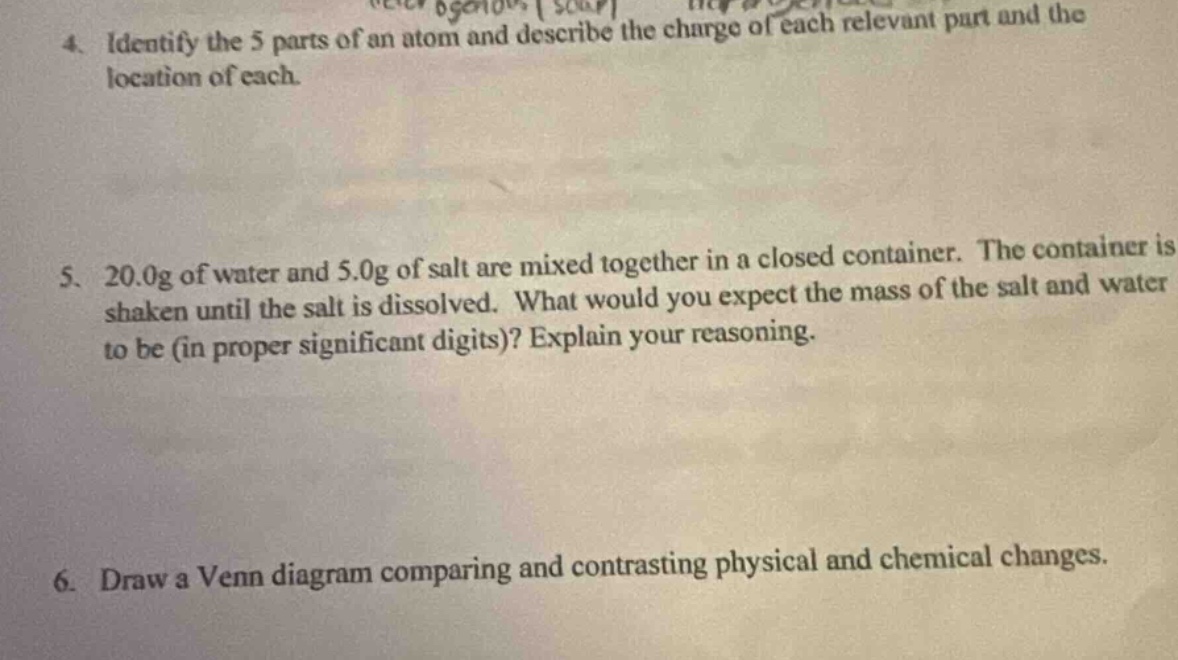
4. identify the 5 parts of an atom and describe the charge of each relevant part and the location of each.\n5. 20.0g of water and 5.0g of salt are mixed together in a closed container. the container is shaken until the salt is dissolved. what would you expect the mass of the salt and water to be (in proper significant digits)? explain your reasoning.\n6. draw a venn diagram comparing and contrasting physical and chemical changes.
Answer
4.
Brief Explanations:
- Proton: Positively - charged, located in the nucleus.
- Neutron: Neutral charge, located in the nucleus.
- Electron: Negatively - charged, located in electron - shells around the nucleus.
- Nucleus: Contains protons and neutrons, positively - charged overall due to protons.
- Electron cloud: Region where electrons are likely to be found, negatively - charged due to electrons.
Answer:
- Proton: Positive charge, in nucleus.
- Neutron: No charge, in nucleus.
- Electron: Negative charge, in electron - shells.
- Nucleus: Positive overall charge, center of atom.
- Electron cloud: Negative charge, surrounds nucleus.
5.
Explanation:
Step1: Apply law of conservation of mass
According to the law of conservation of mass, in a closed system, the total mass before a physical or chemical change is equal to the total mass after the change.
Step2: Calculate total mass
The mass of water is $m_{water}=20.0g$ and the mass of salt is $m_{salt}=5.0g$. The total mass $m = m_{water}+m_{salt}$. $m=20.0g + 5.0g=25.0g$
Answer:
$25.0g$. Reason: Law of conservation of mass in a closed system.
6.
Brief Explanations:
In the overlapping part of the Venn - diagram, put properties that are common to both physical and chemical changes (e.g., both involve a change in a substance). In the non - overlapping part for physical changes, put properties like change in state (solid to liquid), change in shape or size, and no new substances are formed. In the non - overlapping part for chemical changes, put properties like new substances are formed, change in chemical composition, and often involve energy changes (heat, light, etc.).
Answer:
Draw a Venn - diagram with two overlapping circles. Label one "Physical Changes" and the other "Chemical Changes". In the overlapping region, write "Involve a change in a substance". In the "Physical Changes" non - overlapping region, write "Change in state, shape, size; No new substances formed". In the "Chemical Changes" non - overlapping region, write "New substances formed; Change in chemical composition; Energy changes often occur".