identify the strongest intermolecular force that is likely to affect each of the samples described below. a…
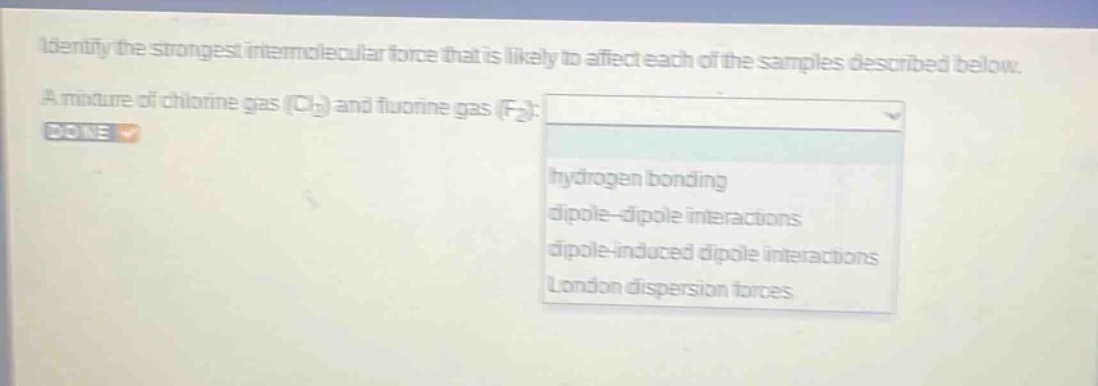
identify the strongest intermolecular force that is likely to affect each of the samples described below. a mixture of chlorine gas (cl₂) and fluorine gas (f₂): hydrogen bonding dipole - dipole interactions dipole - induced dipole interactions london dispersion forces
Answer
Brief Explanations:
Chlorine gas ($Cl_2$) and fluorine gas ($F_2$) are non - polar molecules. Non - polar molecules only exhibit London dispersion forces as their intermolecular forces. Hydrogen bonding occurs when hydrogen is bonded to a highly electronegative atom like N, O, or F. Dipole - dipole interactions are between polar molecules. Dipole - induced dipole interactions involve a polar molecule inducing a dipole in a non - polar molecule. Since $Cl_2$ and $F_2$ are non - polar, the strongest intermolecular force is London dispersion forces.
Answer:
London dispersion forces