identifying the 5 types of chemical reactions\nidentify each of the reactions below as one of the 5 types of…
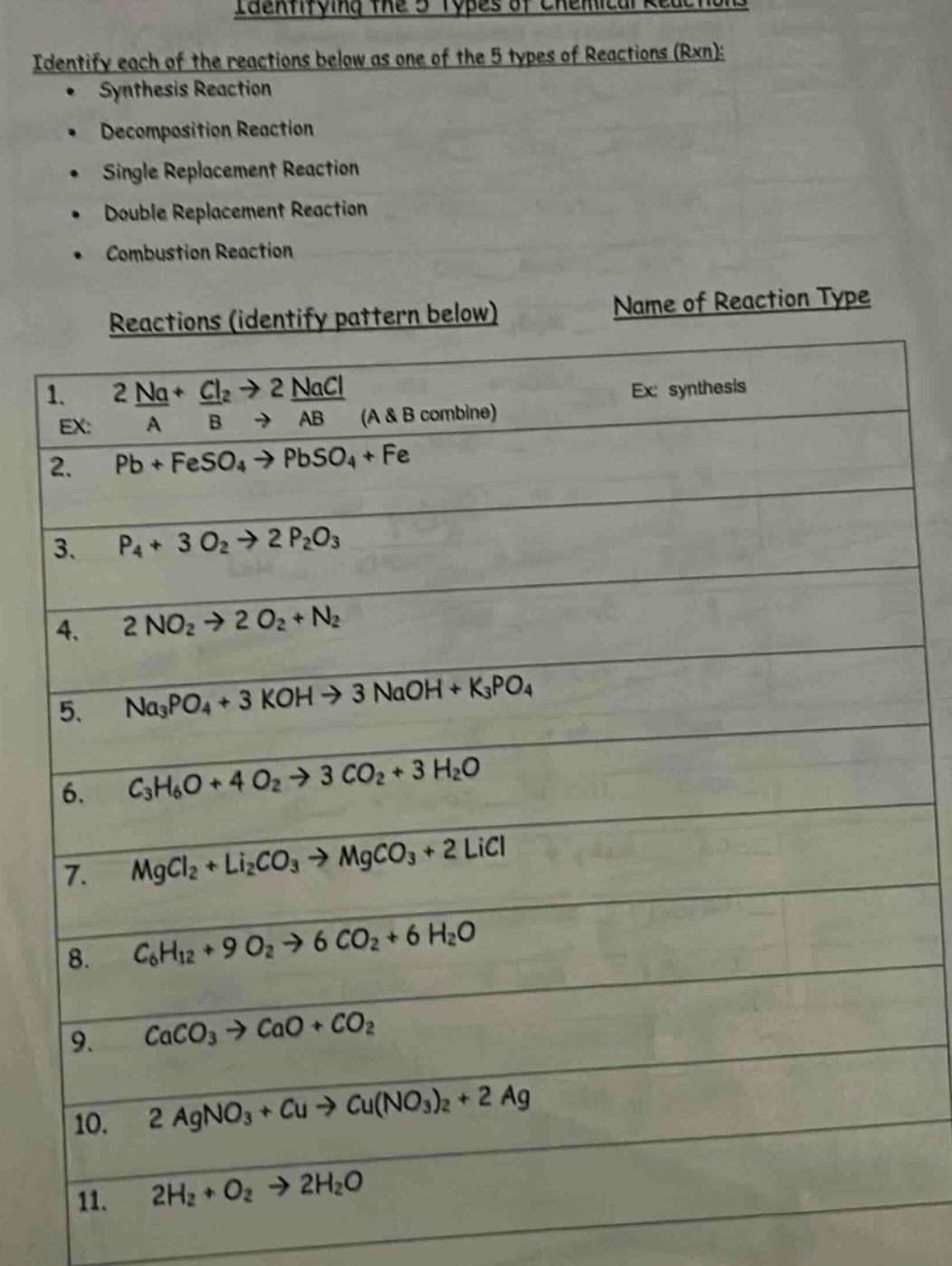
identifying the 5 types of chemical reactions\nidentify each of the reactions below as one of the 5 types of reactions (rxn):\n- synthesis reaction\n- decomposition reaction\n- single replacement reaction\n- double replacement reaction\n- combustion reaction\nreactions (identify pattern below) name of reaction type\n1. 2 na + cl₂ → 2 nacl\nex: a b → ab (a & b combine) ex: synthesis\n2. pb + feso₄ → pbso₄ + fe\n3. p₄ + 3 o₂ → 2 p₂o₃\n4. 2 no₂ → 2 o₂ + n₂\n5. na₃po₄ + 3 koh → 3 naoh + k₃po₄\n6. c₃h₆o + 4 o₂ → 3 co₂ + 3 h₂o\n7. mgcl₂ + li₂co₃ → mgco₃ + 2 licl\n8. c₆h₁₂ + 9 o₂ → 6 co₂ + 6 h₂o\n9. caco₃ → cao + co₂\n10. 2 agno₃ + cu → cu(no₃)₂ + 2 ag\n11. 2h₂ + o₂ → 2h₂o
Answer
Explanation:
Step1: Recall reaction - type definitions
Synthesis: A + B → AB; Decomposition: AB → A + B; Single - replacement: A + BC → AC + B; Double - replacement: AB+CD → AD + CB; Combustion: Hydrocarbon + O₂ → CO₂ + H₂O.
Step2: Analyze reaction 2
Pb + FeSO₄ → PbSO₄ + Fe. Here, Pb replaces Fe in FeSO₄. It is a single - replacement reaction.
Step3: Analyze reaction 3
P₄ + 3O₂ → 2P₂O₃. Phosphorus and oxygen combine to form a single product. It is a synthesis reaction.
Step4: Analyze reaction 4
2NO₂ → 2O₂ + N₂. A single compound breaks down into two elements. It is a decomposition reaction.
Step5: Analyze reaction 5
Na₃PO₄ + 3KOH → 3NaOH + K₃PO₄. The cations and anions of two compounds exchange places. It is a double - replacement reaction.
Step6: Analyze reaction 6
C₃H₆O + 4O₂ → 3CO₂ + 3H₂O. A compound containing carbon, hydrogen, and oxygen reacts with oxygen to produce carbon dioxide and water. It is a combustion reaction.
Step7: Analyze reaction 7
MgCl₂ + Li₂CO₃ → MgCO₃ + 2LiCl. The cations and anions of two compounds exchange. It is a double - replacement reaction.
Step8: Analyze reaction 8
C₆H₁₂ + 9O₂ → 6CO₂ + 6H₂O. A hydrocarbon reacts with oxygen to give carbon dioxide and water. It is a combustion reaction.
Step9: Analyze reaction 9
CaCO₃ → CaO + CO₂. A single compound breaks into two compounds. It is a decomposition reaction.
Step10: Analyze reaction 10
2AgNO₃ + Cu → Cu(NO₃)₂ + 2Ag. Cu replaces Ag in AgNO₃. It is a single - replacement reaction.
Step11: Analyze reaction 11
2H₂ + O₂ → 2H₂O. Hydrogen and oxygen combine to form water. It is a synthesis reaction.
Answer:
- Single - replacement
- Synthesis
- Decomposition
- Double - replacement
- Combustion
- Double - replacement
- Combustion
- Decomposition
- Single - replacement
- Synthesis