the information below describes a redox reaction.\ncr^{3 + }(aq)+2cl^{-}(aq)→cr(s)+cl_{2}(g)\n2cl^{-}(aq)→cl_…
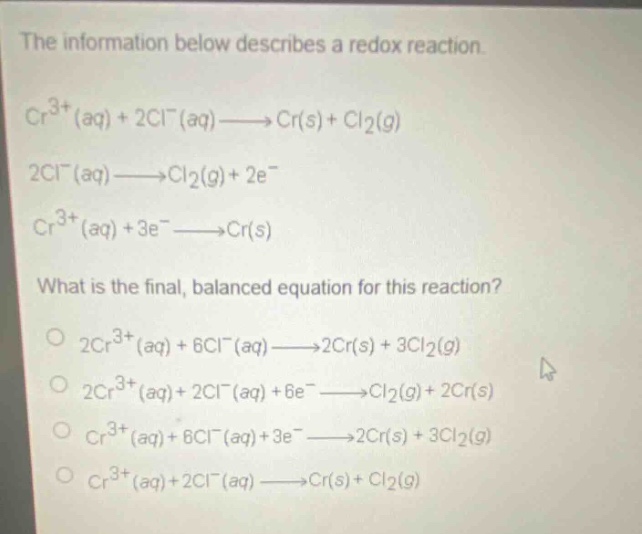
the information below describes a redox reaction.\ncr^{3 + }(aq)+2cl^{-}(aq)→cr(s)+cl_{2}(g)\n2cl^{-}(aq)→cl_{2}(g)+2e^{-}\ncr^{3 + }(aq)+3e^{-}→cr(s)\nwhat is the final, balanced equation for this reaction?\no 2cr^{3 + }(aq)+6cl^{-}(aq)→2cr(s)+3cl_{2}(g)\no 2cr^{3 + }(aq)+2cl^{-}(aq)+6e^{-}→cl_{2}(g)+2cr(s)\no cr^{3 + }(aq)+6cl^{-}(aq)+3e^{-}→2cr(s)+3cl_{2}(g)\no cr^{3 + }(aq)+2cl^{-}(aq)→cr(s)+cl_{2}(g)
Answer
Answer:
A. $2Cr^{3 + }(aq)+6Cl^{-}(aq)\longrightarrow2Cr(s)+3Cl_{2}(g)$
Explanation:
Step1: Balance electrons in half - reactions
The oxidation half - reaction is $2Cl^{-}(aq)\longrightarrow Cl_{2}(g)+2e^{-}$, and the reduction half - reaction is $Cr^{3 + }(aq)+3e^{-}\longrightarrow Cr(s)$. The least common multiple of 2 and 3 (the number of electrons in each half - reaction) is 6. Multiply the oxidation half - reaction by 3 and the reduction half - reaction by 2. Oxidation: $3\times(2Cl^{-}(aq)\longrightarrow Cl_{2}(g)+2e^{-})$ gives $6Cl^{-}(aq)\longrightarrow3Cl_{2}(g)+6e^{-}$ Reduction: $2\times(Cr^{3 + }(aq)+3e^{-}\longrightarrow Cr(s))$ gives $2Cr^{3 + }(aq)+6e^{-}\longrightarrow2Cr(s)$
Step2: Combine half - reactions
Add the two balanced half - reactions together: $2Cr^{3 + }(aq)+6e^{-}+6Cl^{-}(aq)\longrightarrow2Cr(s)+3Cl_{2}(g)+6e^{-}$ Cancel out the electrons on both sides to get the final balanced equation: $2Cr^{3 + }(aq)+6Cl^{-}(aq)\longrightarrow2Cr(s)+3Cl_{2}(g)$