ionic bonding - lewis dot structures\nionic bond - bond between a metal and a non - metal. electrons are…
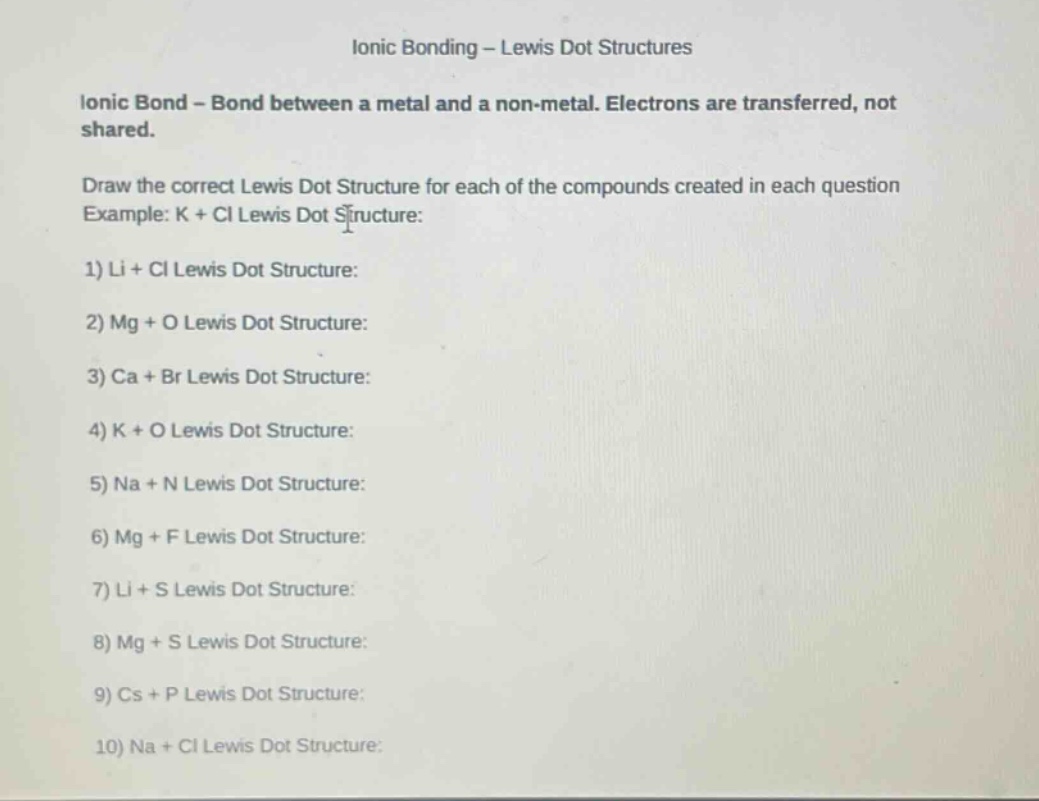
ionic bonding - lewis dot structures\nionic bond - bond between a metal and a non - metal. electrons are transferred, not shared.\ndraw the correct lewis dot structure for each of the compounds created in each question\nexample: k + cl lewis dot structure:\n1) li + cl lewis dot structure:\n2) mg + o lewis dot structure:\n3) ca + br lewis dot structure:\n4) k + o lewis dot structure:\n5) na + n lewis dot structure:\n6) mg + f lewis dot structure:\n7) li + s lewis dot structure:\n8) mg + s lewis dot structure:\n9) cs + p lewis dot structure:\n10) na + cl lewis dot structure:
Answer
Explanation:
Step1: Determine valence electrons
For Li (Group 1), 1 valence - electron; Cl (Group 17), 7 valence - electrons. Li loses its 1 electron to Cl. Li becomes $Li^+$ and Cl becomes $Cl^-$. The Lewis - dot structure for LiCl: $Li^+[:\ddot{Cl}:]^-$
Step2: For Mg and O
Mg (Group 2) has 2 valence electrons, O (Group 16) has 6 valence electrons. Mg loses 2 electrons to O. Mg becomes $Mg^{2 + }$ and O becomes $O^{2 - }$. The Lewis - dot structure for MgO: $Mg^{2+}[:\ddot{O}:]^{2 - }$
Step3: For Ca and Br
Ca (Group 2) has 2 valence electrons, Br (Group 17) has 7 valence electrons. Ca loses 2 electrons, one to each of two Br atoms. Ca becomes $Ca^{2+}$ and each Br becomes $Br^-$. The Lewis - dot structure for $CaBr_2$: $Ca^{2+}[:\ddot{Br}:]^-[:\ddot{Br}:]^-$
Step4: For K and O
K (Group 1) has 1 valence electron, O (Group 16) has 6 valence electrons. Two K atoms each lose 1 electron to O. K becomes $K^+$ and O becomes $O^{2 - }$. The Lewis - dot structure for $K_2O$: $K^+[:\ddot{O}:]^{2 - }K^+$
Step5: For Na and N
Na (Group 1) has 1 valence electron, N (Group 15) has 5 valence electrons. Three Na atoms each lose 1 electron to N. Na becomes $Na^+$ and N becomes $N^{3 - }$. The Lewis - dot structure for $Na_3N$: $Na^+Na^+Na^+[:\ddot{N}:]^{3 - }$
Step6: For Mg and F
Mg (Group 2) has 2 valence electrons, F (Group 17) has 7 valence electrons. Mg loses 2 electrons, one to each of two F atoms. Mg becomes $Mg^{2+}$ and each F becomes $F^-$. The Lewis - dot structure for $MgF_2$: $Mg^{2+}[:\ddot{F}:]^-[:\ddot{F}:]^-$
Step7: For Li and S
Li (Group 1) has 1 valence electron, S (Group 16) has 6 valence electrons. Two Li atoms each lose 1 electron to S. Li becomes $Li^+$ and S becomes $S^{2 - }$. The Lewis - dot structure for $Li_2S$: $Li^+[:\ddot{S}:]^{2 - }Li^+$
Step8: For Mg and S
Mg (Group 2) has 2 valence electrons, S (Group 16) has 6 valence electrons. Mg loses 2 electrons to S. Mg becomes $Mg^{2+}$ and S becomes $S^{2 - }$. The Lewis - dot structure for MgS: $Mg^{2+}[:\ddot{S}:]^{2 - }$
Step9: For Cs and P
Cs (Group 1) has 1 valence electron, P (Group 15) has 5 valence electrons. Three Cs atoms each lose 1 electron to P. Cs becomes $Cs^+$ and P becomes $P^{3 - }$. The Lewis - dot structure for $Cs_3P$: $Cs^+Cs^+Cs^+[:\ddot{P}:]^{3 - }$
Step10: For Na and Cl
Na (Group 1) has 1 valence electron, Cl (Group 17) has 7 valence electrons. Na loses its 1 electron to Cl. Na becomes $Na^+$ and Cl becomes $Cl^-$. The Lewis - dot structure for NaCl: $Na^+[:\ddot{Cl}:]^-$
Answer:
- $Li^+[:\ddot{Cl}:]^-$
- $Mg^{2+}[:\ddot{O}:]^{2 - }$
- $Ca^{2+}[:\ddot{Br}:]^-[:\ddot{Br}:]^-$
- $K^+[:\ddot{O}:]^{2 - }K^+$
- $Na^+Na^+Na^+[:\ddot{N}:]^{3 - }$
- $Mg^{2+}[:\ddot{F}:]^-[:\ddot{F}:]^-$
- $Li^+[:\ddot{S}:]^{2 - }Li^+$
- $Mg^{2+}[:\ddot{S}:]^{2 - }$
- $Cs^+Cs^+Cs^+[:\ddot{P}:]^{3 - }$
- $Na^+[:\ddot{Cl}:]^-$