ionic bonds - what are some common examples of substances that exhibit this bond? list at least 3 examples…
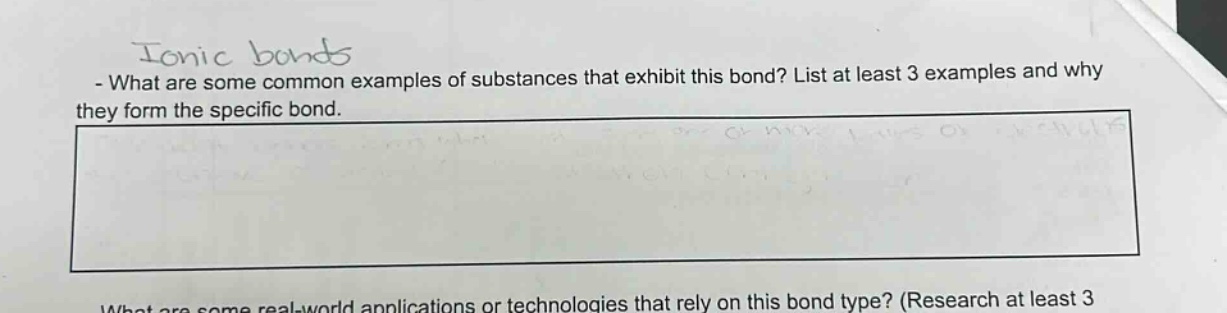
ionic bonds - what are some common examples of substances that exhibit this bond? list at least 3 examples and why they form the specific bond.
Answer
Brief Explanations:
Ionic bonds form between a metal and a non - metal through the transfer of electrons. Sodium chloride (NaCl) forms an ionic bond as sodium donates an electron to chlorine to achieve stable electron configurations. Calcium fluoride (CaF₂) has calcium losing two electrons to two fluorine atoms. Magnesium oxide (MgO) is formed when magnesium gives two electrons to oxygen. In real - world applications, ionic compounds are used in salt for de - icing roads (NaCl), in batteries (e.g., lithium - ion batteries which rely on movement of ions), and in ceramics (e.g., magnesium oxide ceramics which are heat - resistant due to strong ionic bonds).
Answer:
Common examples: Sodium chloride (NaCl): Sodium donates an electron to chlorine for stable configurations. Calcium fluoride (CaF₂): Calcium loses two electrons to two fluorine atoms. Magnesium oxide (MgO): Magnesium gives two electrons to oxygen. Real - world applications: Salt for de - icing roads (NaCl), batteries (e.g., lithium - ion batteries), ceramics (e.g., magnesium oxide ceramics).