why can ionic table salt and covalent rubbing alcohol both dissolve in water?\nalcohols polar bonds and…
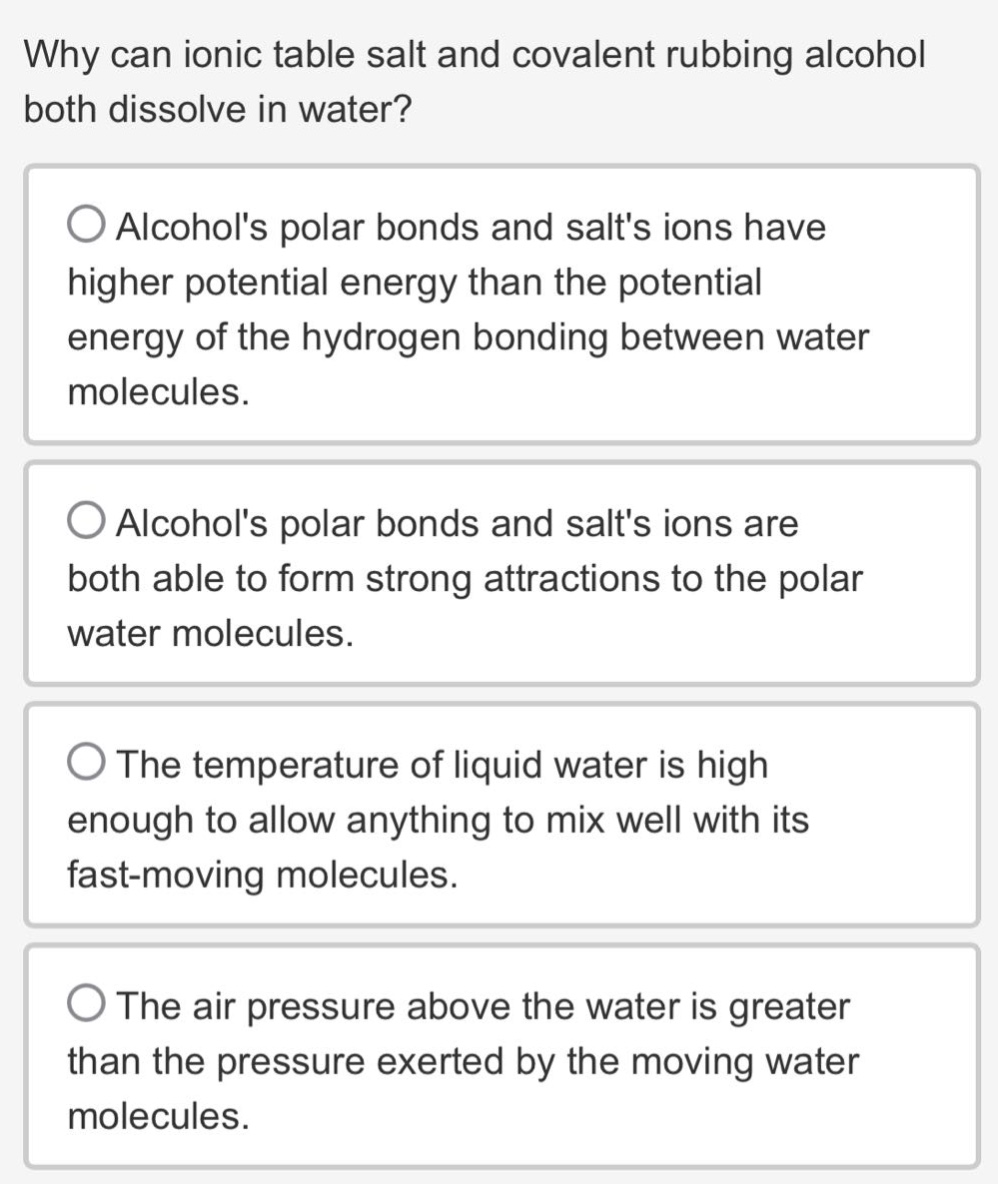
why can ionic table salt and covalent rubbing alcohol both dissolve in water?\nalcohols polar bonds and salts ions have higher potential energy than the potential energy of the hydrogen bonding between water molecules.\nalcohols polar bonds and salts ions are both able to form strong attractions to the polar water molecules.\nthe temperature of liquid water is high enough to allow anything to mix well with its fast - moving molecules.\nthe air pressure above the water is greater than the pressure exerted by the moving water molecules.
Answer
Brief Explanations:
Water is a polar molecule. Rubbing alcohol has polar bonds and table - salt consists of ions. Polar substances and ions can form strong attractions (such as hydrogen - bonding for alcohol and ion - dipole interactions for salt) with polar water molecules, which allows them to dissolve. The other options are incorrect as potential energy comparison in option 1 is not the main reason, water doesn't dissolve everything as stated in option 3, and air pressure is not relevant to the solubility of these substances in water as in option 4.
Answer:
Alcohol's polar bonds and salt's ions are both able to form strong attractions to the polar water molecules.