kcl(aq) + cas(aq) →\nexpress your answer as a complete chemical equation including phases. enter noreaction…
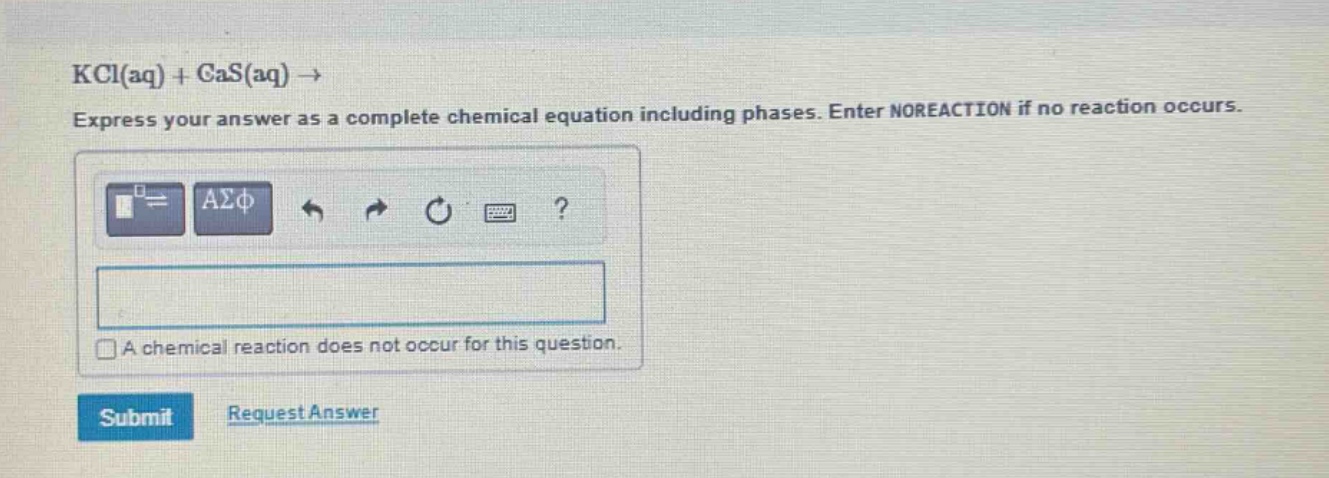
kcl(aq) + cas(aq) →\nexpress your answer as a complete chemical equation including phases. enter noreaction if no reaction occurs.\na chemical reaction does not occur for this question.
Answer
Explanation:
Step1: Predict products
When potassium chloride ($KCl$) and calcium sulfide ($CaS$) react in an aqueous - solution, a double - displacement reaction may occur. The possible products are potassium sulfide ($K_2S$) and calcium chloride ($CaCl_2$). The general form of a double - displacement reaction is $AB + CD\rightarrow AD+CB$. Here, $A = K$, $B = Cl$, $C = Ca$, and $D = S$. The balanced chemical equation for the potential reaction is $2KCl(aq)+CaS(aq)\rightarrow K_2S(aq)+CaCl_2(aq)$.
Step2: Check solubility
According to solubility rules, all potassium salts ($K^+$) are soluble, all calcium salts ($Ca^{2 + }$) are soluble, all chlorides ($Cl^-$) are soluble except for $AgCl$, $Hg_2Cl_2$, and $PbCl_2$, and most sulfides ($S^{2 - }$) are insoluble except for those of alkali metals and ammonium. Potassium sulfide ($K_2S$) and calcium chloride ($CaCl_2$) are both soluble in water. Since no precipitate, gas, or weak - electrolyte is formed, no chemical reaction occurs.
Answer:
NOREACTION