label whether the following compounds are ionic or covalent. then name them using appropriate rules.\n1…
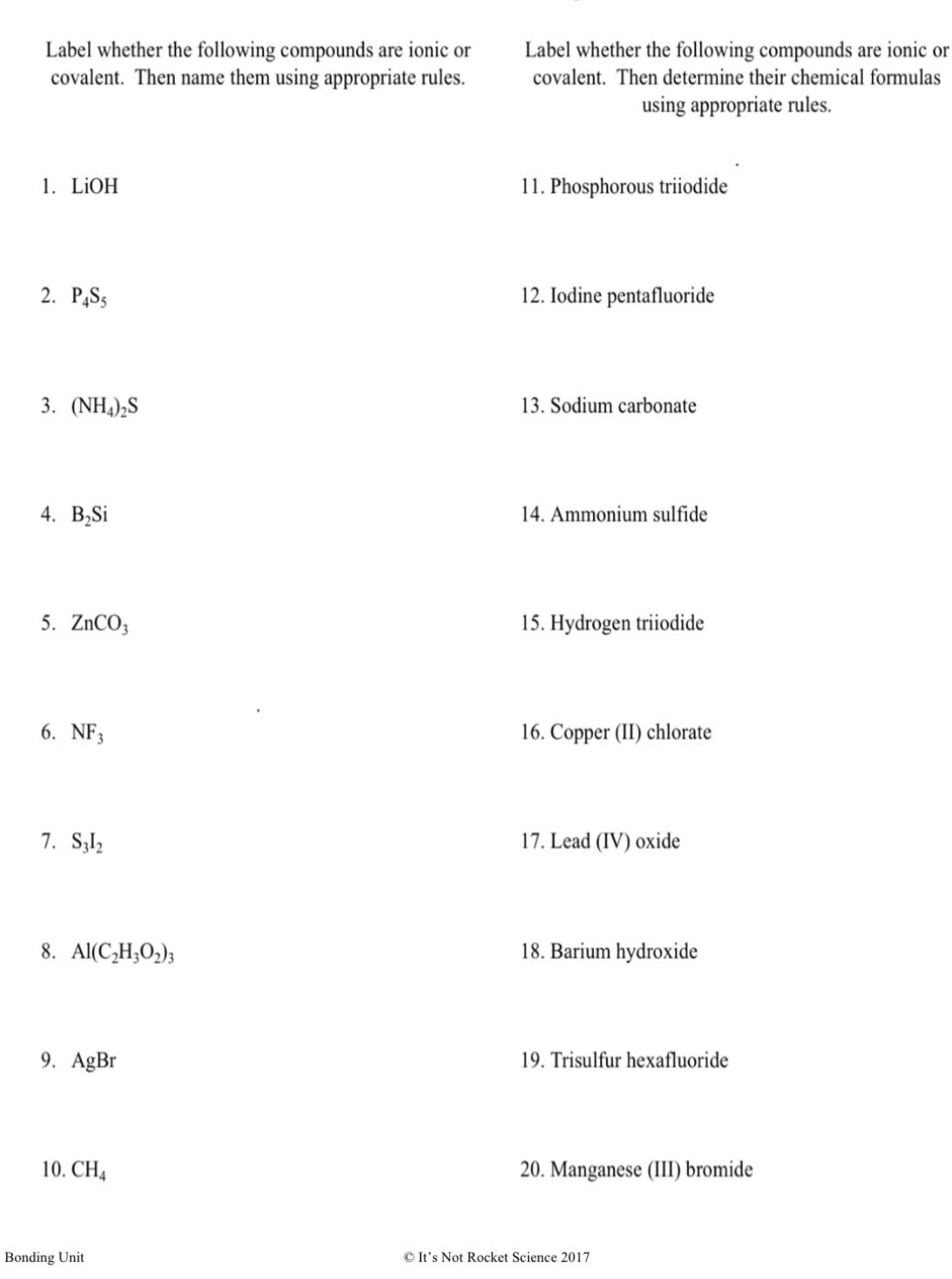
label whether the following compounds are ionic or covalent. then name them using appropriate rules.\n1. lioh\n2. p₄s₅\n3. (nh₄)₂s\n4. b₂si\n5. znco₃\n6. nf₃\n7. s₃i₂\n8. al(c₂h₃o₂)₃\n9. agbr\n10. ch₄\nlabel whether the following compounds are ionic or covalent. then determine their chemical formulas using appropriate rules.\n11. phosphorous triiodide\n12. iodine pentafluoride\n13. sodium carbonate\n14. ammonium sulfide\n15. hydrogen triiodide\n16. copper (ii) chlorate\n17. lead (iv) oxide\n18. barium hydroxide\n19. trisulfur hexafluoride\n20. manganese (iii) bromide
Answer
Explanation:
Step1: Recall ionic and covalent compound rules
Ionic compounds usually form between metals and non - metals or polyatomic ions and metals/non - metals. Covalent compounds form between non - metals.
Step2: Analyze compound 1 (LiOH)
Lithium (Li) is a metal and hydroxide ($OH^-$) is a polyatomic ion. So, it is an ionic compound. Name: Lithium hydroxide.
Step3: Analyze compound 2 ($P_4S_5$)
Both phosphorus (P) and sulfur (S) are non - metals. So, it is a covalent compound. Name: Tetraphosphorus pentasulfide.
Step4: Analyze compound 3 ($(NH_4)_2S$)
Ammonium ($NH_4^+$) is a polyatomic ion and sulfur (S) is a non - metal. So, it is an ionic compound. Name: Ammonium sulfide.
Step5: Analyze compound 4 ($B_2Si$)
Boron (B) and silicon (Si) are non - metals. So, it is a covalent compound. Name: Diboron silicide.
Step6: Analyze compound 5 ($ZnCO_3$)
Zinc (Zn) is a metal and carbonate ($CO_3^{2 - }$) is a polyatomic ion. So, it is an ionic compound. Name: Zinc carbonate.
Step7: Analyze compound 6 ($NF_3$)
Nitrogen (N) and fluorine (F) are non - metals. So, it is a covalent compound. Name: Nitrogen trifluoride.
Step8: Analyze compound 7 ($S_3I_2$)
Both sulfur (S) and iodine (I) are non - metals. So, it is a covalent compound. Name: Trisulfur diiodide.
Step9: Analyze compound 8 ($Al(C_2H_3O_2)_3$)
Aluminum (Al) is a metal and acetate ($C_2H_3O_2^-$) is a polyatomic ion. So, it is an ionic compound. Name: Aluminum acetate.
Step10: Analyze compound 9 (AgBr)
Silver (Ag) is a metal and bromine (Br) is a non - metal. So, it is an ionic compound. Name: Silver bromide.
Step11: Analyze compound 10 ($CH_4$)
Carbon (C) and hydrogen (H) are non - metals. So, it is a covalent compound. Name: Methane.
Step12: Analyze compound 11 (Phosphorous triiodide)
It is a covalent compound. Formula: $PI_3$.
Step13: Analyze compound 12 (Iodine pentafluoride)
It is a covalent compound. Formula: $IF_5$.
Step14: Analyze compound 13 (Sodium carbonate)
Sodium (Na) is a metal and carbonate ($CO_3^{2 - }$) is a polyatomic ion. It is an ionic compound. Formula: $Na_2CO_3$.
Step15: Analyze compound 14 (Ammonium sulfide)
Ammonium ($NH_4^+$) is a polyatomic ion and sulfur (S) is a non - metal. It is an ionic compound. Formula: $(NH_4)_2S$.
Step16: Analyze compound 15 (Hydrogen triiodide)
It is a covalent compound. Formula: $HI_3$.
Step17: Analyze compound 16 (Copper (II) chlorate)
Copper (Cu) is a metal and chlorate ($ClO_3^-$) is a polyatomic ion. It is an ionic compound. Formula: $Cu(ClO_3)_2$.
Step18: Analyze compound 17 (Lead (IV) oxide)
Lead (Pb) is a metal and oxygen (O) is a non - metal. It is an ionic compound. Formula: $PbO_2$.
Step19: Analyze compound 18 (Barium hydroxide)
Barium (Ba) is a metal and hydroxide ($OH^-$) is a polyatomic ion. It is an ionic compound. Formula: $Ba(OH)_2$.
Step20: Analyze compound 19 (Trisulfur hexafluoride)
It is a covalent compound. Formula: $S_3F_6$.
Step21: Analyze compound 20 (Manganese (III) bromide)
Manganese (Mn) is a metal and bromine (Br) is a non - metal. It is an ionic compound. Formula: $MnBr_3$.
Answer:
- Ionic, Lithium hydroxide
- Covalent, Tetraphosphorus pentasulfide
- Ionic, Ammonium sulfide
- Covalent, Diboron silicide
- Ionic, Zinc carbonate
- Covalent, Nitrogen trifluoride
- Covalent, Trisulfur diiodide
- Ionic, Aluminum acetate
- Ionic, Silver bromide
- Covalent, Methane
- Covalent, $PI_3$
- Covalent, $IF_5$
- Ionic, $Na_2CO_3$
- Ionic, $(NH_4)_2S$
- Covalent, $HI_3$
- Ionic, $Cu(ClO_3)_2$
- Ionic, $PbO_2$
- Ionic, $Ba(OH)_2$
- Covalent, $S_3F_6$
- Ionic, $MnBr_3$