during a laboratory experiment, a student filled a balloon with two different gases, co₂ and n₂. the…
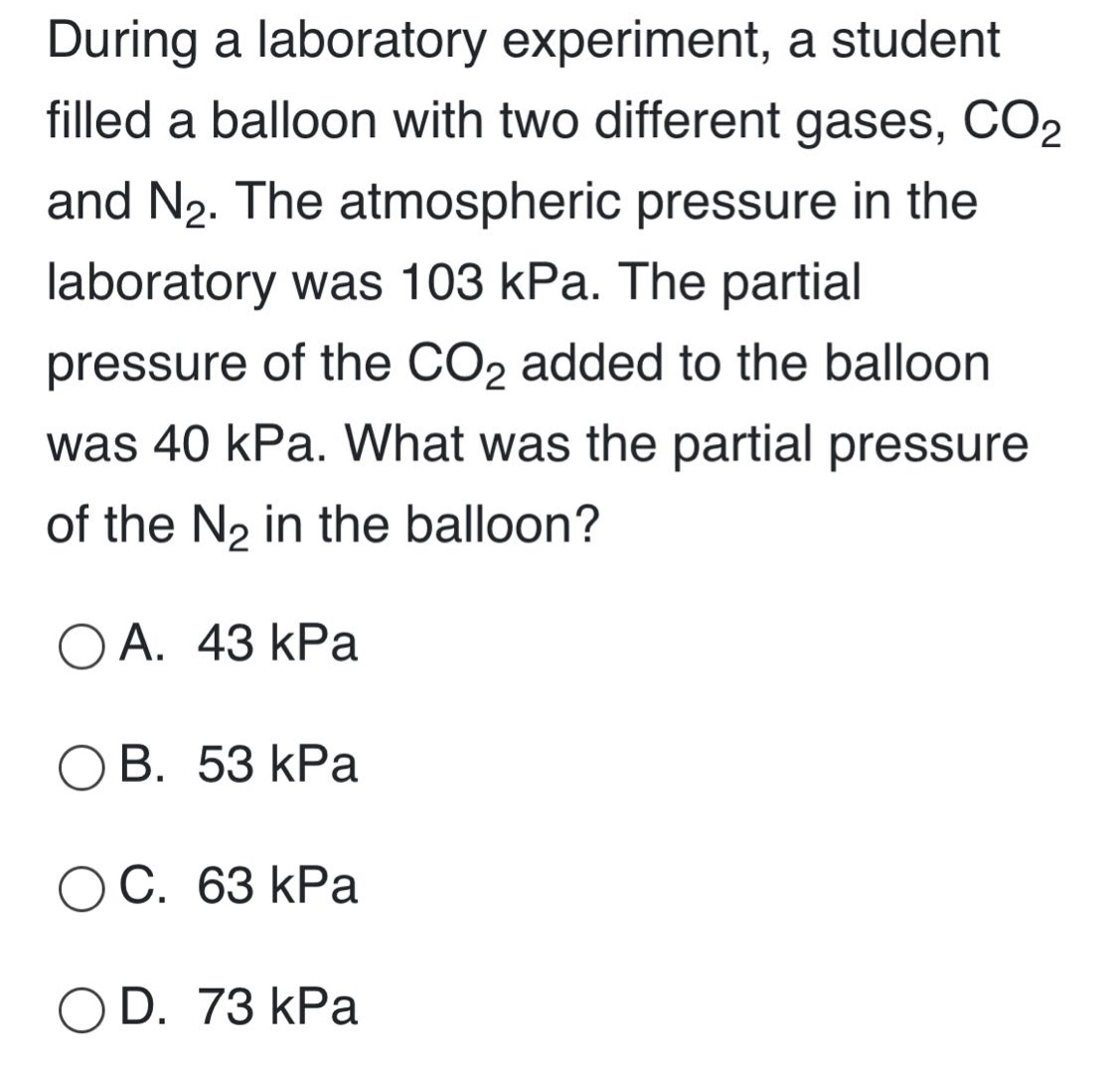
during a laboratory experiment, a student filled a balloon with two different gases, co₂ and n₂. the atmospheric pressure in the laboratory was 103 kpa. the partial pressure of the co₂ added to the balloon was 40 kpa. what was the partial pressure of the n₂ in the balloon?\n\na. 43 kpa\nb. 53 kpa\nc. 63 kpa\nd. 73 kpa
Answer
Explanation:
Step1: Recall Dalton's law
According to Dalton's law of partial - pressures, the total pressure ($P_{total}$) of a gas mixture is the sum of the partial pressures of its components. So, $P_{total}=P_{CO_2}+P_{N_2}$.
Step2: Rearrange the formula
We want to find $P_{N_2}$, so we can rewrite the formula as $P_{N_2}=P_{total}-P_{CO_2}$.
Step3: Substitute values
Given that $P_{total} = 103$ kPa and $P_{CO_2}=40$ kPa. Then $P_{N_2}=103 - 40$. $P_{N_2}=63$ kPa
Answer:
C. 63 kPa