lakshmi has a sample of ammonium nitrate (nh₄no₃) that has a mass of 40.10 g. she knows that the molar mass…
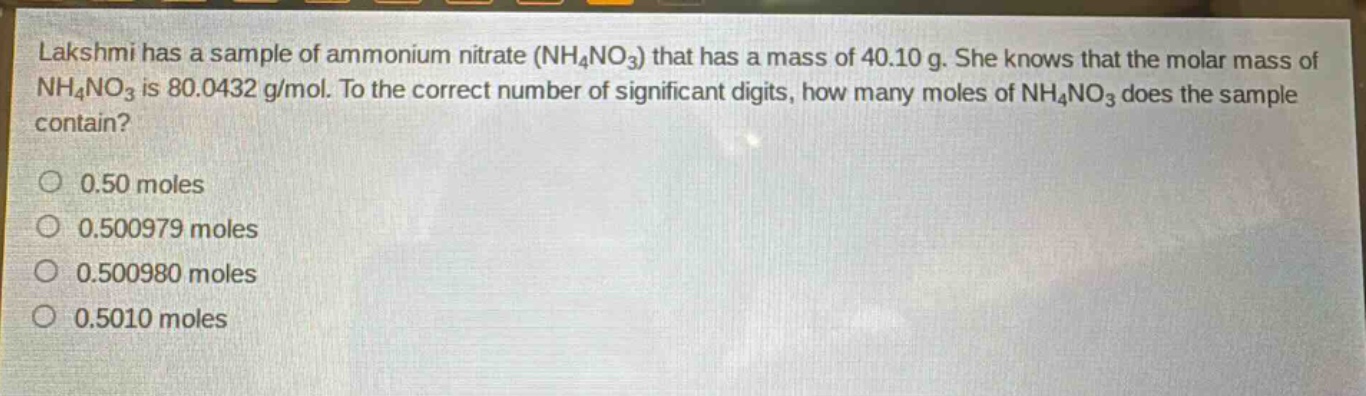
lakshmi has a sample of ammonium nitrate (nh₄no₃) that has a mass of 40.10 g. she knows that the molar mass of nh₄no₃ is 80.0432 g/mol. to the correct number of significant digits, how many moles of nh₄no₃ does the sample contain?\n\no 0.50 moles\no 0.500979 moles\no 0.500980 moles\no 0.5010 moles
Answer
Explanation:
Step1: Recall mole - mass formula
The formula to calculate the number of moles $n$ is $n=\frac{m}{M}$, where $m$ is the mass of the substance and $M$ is the molar mass.
Step2: Substitute given values
We have $m = 40.10\ g$ and $M=80.0432\ g/mol$. So $n=\frac{40.10}{80.0432}$.
Step3: Calculate the number of moles
$n=\frac{40.10}{80.0432}\approx0.500980\ mol$.
Step4: Apply significant - digit rules
The mass $40.10\ g$ has four significant digits. So the result should be reported to four significant digits. Rounding $0.500980$ to four significant digits gives $0.5010\ mol$.
Answer:
D. 0.5010 moles