limiting reactants introduction\npart 2: making ammonia\nconsider the balanced chemical equation: 1 n₂ + 3…
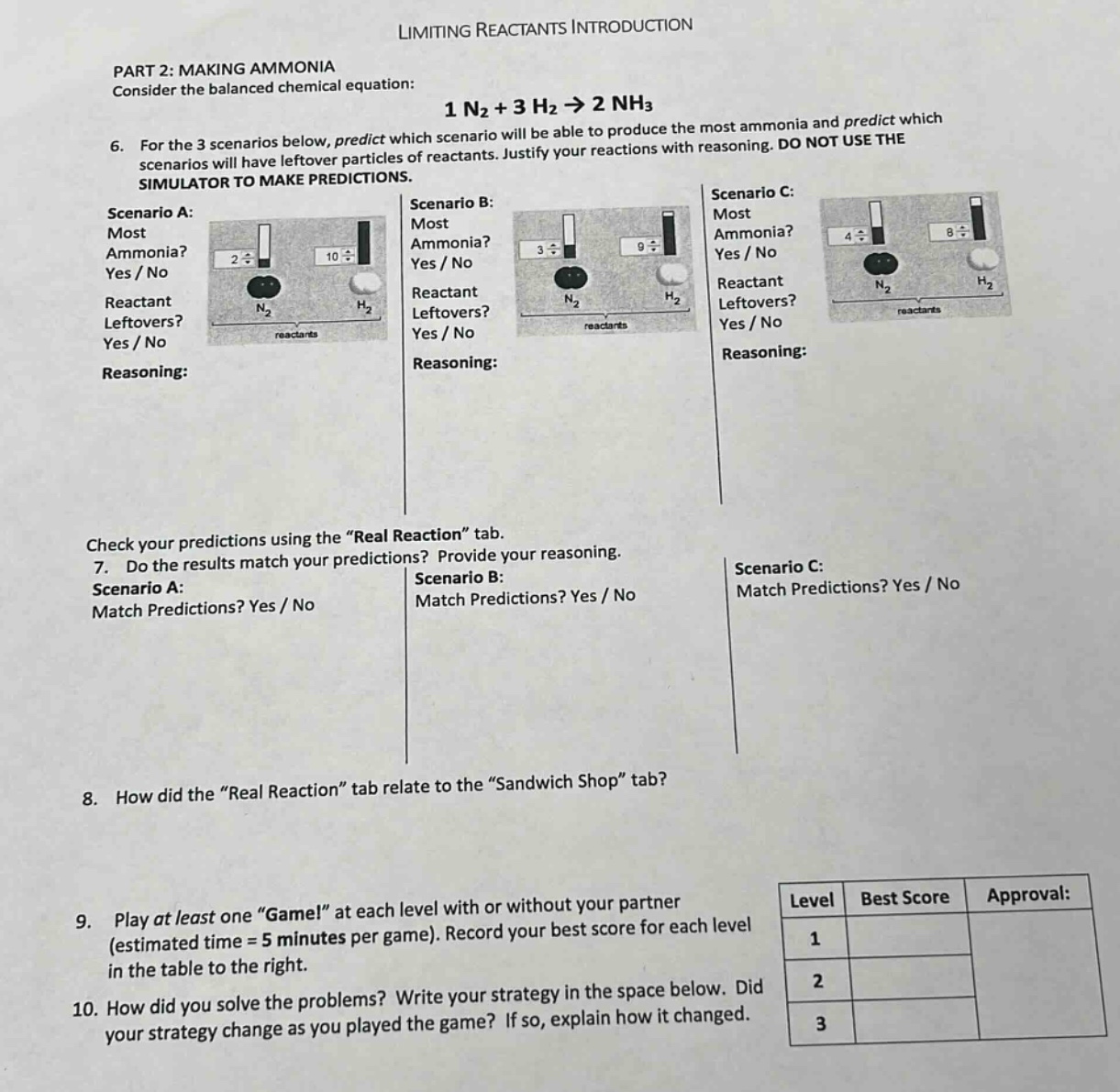
limiting reactants introduction\npart 2: making ammonia\nconsider the balanced chemical equation: 1 n₂ + 3 h₂ → 2 nh₃\n6. for the 3 scenarios below, predict which scenario will be able to produce the most ammonia and predict which scenarios will have leftover particles of reactants. justify your reactions with reasoning. do not use the simulator to make predictions.\nscenario a:\nmost\nammonia?\nyes / no\nreactant\nleftovers?\nyes / no\nreasoning:\nscenario b:\nmost\nammonia?\nyes / no\nreactant\nleftovers?\nyes / no\nreasoning:\nscenario c:\nmost\nammonia?\nyes / no\nreactant\nleftovers?\nyes / no\nreasoning:\ncheck your predictions using the “real reaction” tab.\n7. do the results match your predictions? provide your reasoning.\nscenario a:\nmatch predictions? yes / no\nscenario b:\nmatch predictions? yes / no\nscenario c:\nmatch predictions? yes / no\n8. how did the “real reaction” tab relate to the “sandwich shop” tab?\n9. play at least one “game!” at each level with or without your partner (estimated time = 5 minutes per game). record your best score for each level in the table to the right.\n10. how did you solve the problems? write your strategy in the space below. did your strategy change as you played the game? if so, explain how it changed.
Answer
Explanation:
Step1: Determine mole - ratio from balanced equation
The balanced equation is $N_2 + 3H_2\rightarrow2NH_3$, so the mole - ratio of $N_2$ to $H_2$ is 1:3.
Step2: Analyze Scenario A
We have 2 moles of $N_2$ and 10 moles of $H_2$. Based on the 1:3 ratio, 2 moles of $N_2$ would require $2\times3 = 6$ moles of $H_2$. Since we have 10 moles of $H_2$, $N_2$ is the limiting reactant. The amount of $NH_3$ produced is based on $N_2$. From the equation, 2 moles of $N_2$ will produce $2\times2=4$ moles of $NH_3$. And there will be $10 - 6=4$ moles of $H_2$ left over.
Step3: Analyze Scenario B
We have 3 moles of $N_2$ and 9 moles of $H_2$. Based on the 1:3 ratio, 3 moles of $N_2$ would require $3\times3 = 9$ moles of $H_2$. So both reactants are completely consumed. The amount of $NH_3$ produced is based on either reactant. From the equation, 3 moles of $N_2$ will produce $3\times2 = 6$ moles of $NH_3$. There are no reactant leftovers.
Step4: Analyze Scenario C
We have 4 moles of $N_2$ and 8 moles of $H_2$. Based on the 1:3 ratio, 8 moles of $H_2$ would require $\frac{8}{3}\approx2.67$ moles of $N_2$. So $H_2$ is the limiting reactant. The amount of $NH_3$ produced is based on $H_2$. From the equation, 8 moles of $H_2$ will produce $\frac{8\times2}{3}\approx5.33$ moles of $NH_3$. And there will be $4-\frac{8}{3}=\frac{4}{3}\approx1.33$ moles of $N_2$ left over.
Step5: Compare amounts of $NH_3$ produced
Scenario B produces 6 moles of $NH_3$, Scenario A produces 4 moles of $NH_3$, and Scenario C produces approximately 5.33 moles of $NH_3$. So Scenario B produces the most ammonia.
Answer:
Scenario A: Most Ammonia? No; Reactant Leftovers? Yes; Reasoning: $N_2$ is limiting, 4 moles of $NH_3$ produced, 4 moles of $H_2$ left over. Scenario B: Most Ammonia? Yes; Reactant Leftovers? No; Reasoning: Both reactants are completely consumed, 6 moles of $NH_3$ produced. Scenario C: Most Ammonia? No; Reactant Leftovers? Yes; Reasoning: $H_2$ is limiting, approximately 5.33 moles of $NH_3$ produced, approximately 1.33 moles of $N_2$ left over.