6. list out 3 different metals, metalloids, and nonmetals using the periodic table\nmetals\nnonmetals\nmetall…
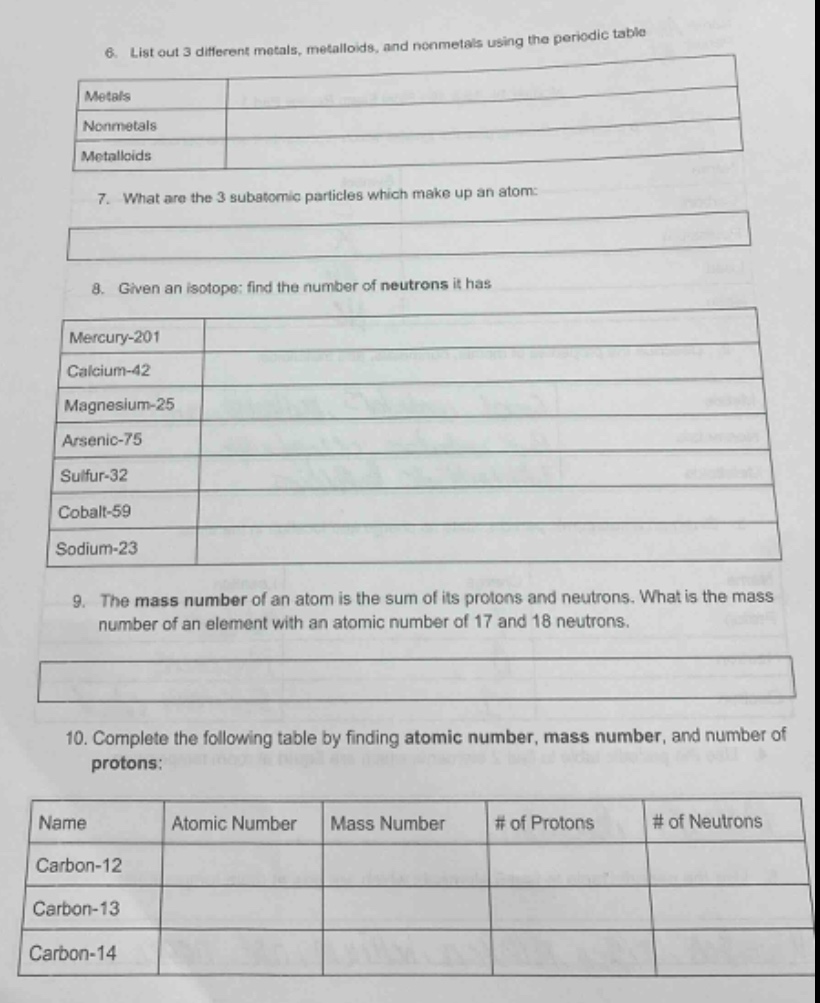
6. list out 3 different metals, metalloids, and nonmetals using the periodic table\nmetals\nnonmetals\nmetalloids\n7. what are the 3 subatomic particles which make up an atom:\n8. given an isotope: find the number of neutrons it has\nmercury - 201\ncalcium - 42\nmagnesium - 25\narsenic - 75\nsulfur - 32\ncobalt - 59\nsodium - 23\n9. the mass number of an atom is the sum of its protons and neutrons. what is the mass number of an element with an atomic number of 17 and 18 neutrons.\n10. complete the following table by finding atomic number, mass number, and number of protons:\nname atomic number mass number # of protons # of neutrons\ncarbon - 12\ncarbon - 13\ncarbon - 14
Answer
Explanation:
Step1: List metals, non - metals and metalloids
Metals: Iron (Fe), Copper (Cu), Aluminum (Al); Non - metals: Oxygen (O), Nitrogen (N), Chlorine (Cl); Metalloids: Silicon (Si), Germanium (Ge), Boron (B)
Step2: Identify subatomic particles
The three subatomic particles that make up an atom are protons, neutrons, and electrons.
Step3: Calculate number of neutrons for isotopes
For Mercury - 201: Atomic number of Hg is 80, number of neutrons = 201 - 80 = 121; For Calcium - 42: Atomic number of Ca is 20, number of neutrons = 42 - 20 = 22; For Magnesium - 25: Atomic number of Mg is 12, number of neutrons = 25 - 12 = 13; For Arsenic - 75: Atomic number of As is 33, number of neutrons = 75 - 33 = 42; For Sulfur - 32: Atomic number of S is 16, number of neutrons = 32 - 16 = 16; For Cobalt - 59: Atomic number of Co is 27, number of neutrons = 59 - 27 = 32; For Sodium - 23: Atomic number of Na is 11, number of neutrons = 23 - 11 = 12.
Step4: Calculate mass number
Given atomic number = 17 and number of neutrons = 18, mass number = 17+18 = 35.
Step5: Complete carbon isotope table
For Carbon - 12: Atomic number = 6, Mass number = 12, # of Protons = 6, # of Neutrons = 12 - 6 = 6; For Carbon - 13: Atomic number = 6, Mass number = 13, # of Protons = 6, # of Neutrons = 13 - 6 = 7; For Carbon - 14: Atomic number = 6, Mass number = 14, # of Protons = 6, # of Neutrons = 14 - 6 = 8.
Answer:
Metals: Iron (Fe), Copper (Cu), Aluminum (Al) Non - metals: Oxygen (O), Nitrogen (N), Chlorine (Cl) Metalloids: Silicon (Si), Germanium (Ge), Boron (B) Subatomic particles: Protons, neutrons, electrons Mercury - 201: 121 neutrons Calcium - 42: 22 neutrons Magnesium - 25: 13 neutrons Arsenic - 75: 42 neutrons Sulfur - 32: 16 neutrons Cobalt - 59: 32 neutrons Sodium - 23: 12 neutrons Mass number: 35 Carbon - 12: Atomic number 6, Mass number 12, # of Protons 6, # of Neutrons 6 Carbon - 13: Atomic number 6, Mass number 13, # of Protons 6, # of Neutrons 7 Carbon - 14: Atomic number 6, Mass number 14, # of Protons 6, # of Neutrons 8