look at the table of dissociation constants for some acids.\n| acid | $k_{a}$ |\n|--|--| \n| acetic acid |…
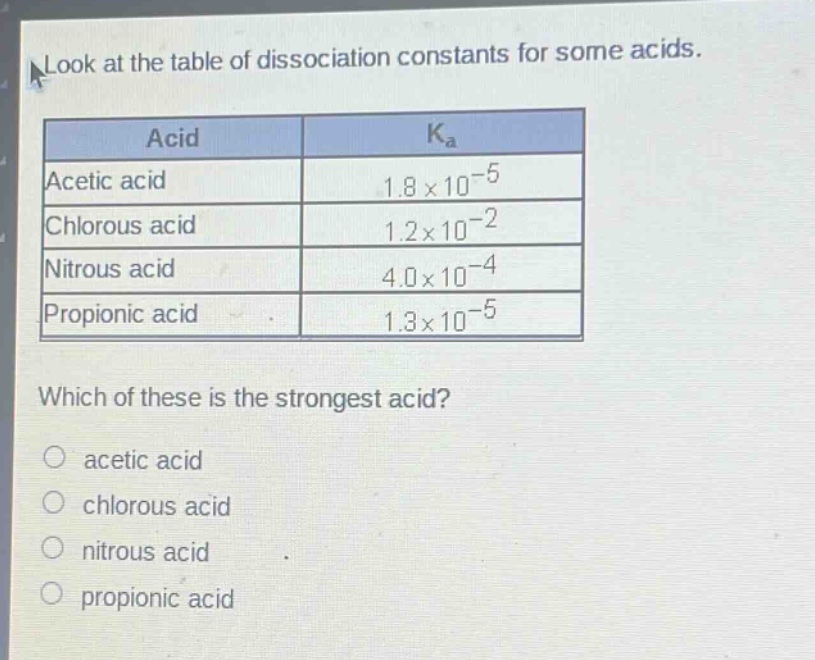
look at the table of dissociation constants for some acids.\n| acid | $k_{a}$ |\n|--|--| \n| acetic acid | $1.8\times10^{-5}$ |\n| chlorous acid | $1.2\times10^{-2}$ |\n| nitrous acid | $4.0\times10^{-4}$ |\n| propionic acid | $1.3\times10^{-5}$ |\nwhich of these is the strongest acid?\n○ acetic acid\n○ chlorous acid\n○ nitrous acid\n○ propionic acid
Answer
Explanation:
Step1: Recall acid - strength rule
The larger the acid dissociation constant ($K_a$), the stronger the acid.
Step2: Compare $K_a$ values
We have $K_a$ values: Acetic acid $K_a = 1.8\times10^{-5}$, Chlorous acid $K_a=1.2\times 10^{-2}$, Nitrous acid $K_a = 4.0\times10^{-4}$, Propionic acid $K_a=1.3\times10^{-5}$. Since $1.2\times 10^{-2}>4.0\times10^{-4}>1.8\times10^{-5}>1.3\times10^{-5}$, chlorous acid has the largest $K_a$ value.
Answer:
chlorous acid