what mass of urea (cn₂h₄o) is produced when 125 grams of ammonia is reacted with 255 grams of carbon dioxide…
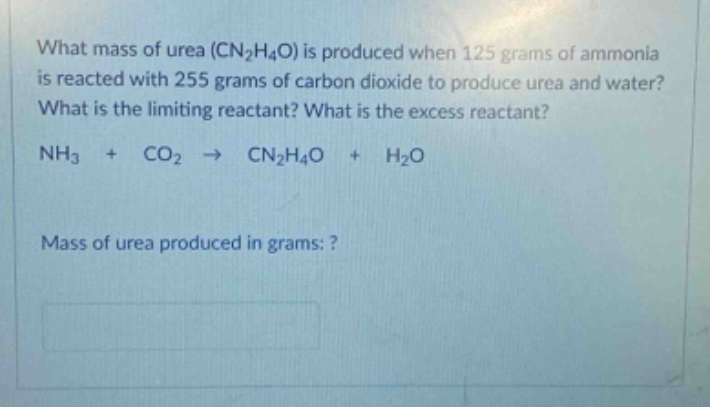
what mass of urea (cn₂h₄o) is produced when 125 grams of ammonia is reacted with 255 grams of carbon dioxide to produce urea and water? what is the limiting reactant? what is the excess reactant? nh₃ + co₂ → cn₂h₄o + h₂o mass of urea produced in grams: ?
Answer
Explanation:
Step1: Balance the chemical equation
$2NH_3 + CO_2\rightarrow CN_2H_4O + H_2O$
Step2: Calculate the molar - masses
The molar mass of $NH_3$: $M_{NH_3}=14 + 3\times1=17\ g/mol$. The molar mass of $CO_2$: $M_{CO_2}=12 + 2\times16 = 44\ g/mol$. The molar mass of $CN_2H_4O$: $M_{CN_2H_4O}=12+2\times14 + 4\times1+16=60\ g/mol$.
Step3: Calculate the number of moles of reactants
The number of moles of $NH_3$, $n_{NH_3}=\frac{m_{NH_3}}{M_{NH_3}}=\frac{125\ g}{17\ g/mol}\approx7.35\ mol$. The number of moles of $CO_2$, $n_{CO_2}=\frac{m_{CO_2}}{M_{CO_2}}=\frac{255\ g}{44\ g/mol}\approx5.80\ mol$.
Step4: Determine the limiting reactant
From the balanced equation, the mole - ratio of $NH_3$ to $CO_2$ is $2:1$. For $n_{CO_2} = 5.80\ mol$, the moles of $NH_3$ required is $n_{NH_3\ required}=2\times n_{CO_2}=2\times5.80\ mol = 11.6\ mol$. But we have only $7.35\ mol$ of $NH_3$. For $n_{NH_3}=7.35\ mol$, the moles of $CO_2$ required is $n_{CO_2\ required}=\frac{n_{NH_3}}{2}=\frac{7.35\ mol}{2}=3.675\ mol$. Since we have more $CO_2$ than required, $NH_3$ is the limiting reactant and $CO_2$ is the excess reactant.
Step5: Calculate the mass of urea produced
From the balanced equation, the mole - ratio of $NH_3$ to $CN_2H_4O$ is $2:1$. The moles of $CN_2H_4O$ produced, $n_{CN_2H_4O}=\frac{n_{NH_3}}{2}=\frac{7.35\ mol}{2}=3.675\ mol$. The mass of $CN_2H_4O$ produced, $m_{CN_2H_4O}=n_{CN_2H_4O}\times M_{CN_2H_4O}=3.675\ mol\times60\ g/mol = 220.5\ g$.
Answer:
The mass of urea produced is $220.5\ g$. The limiting reactant is $NH_3$ and the excess reactant is $CO_2$.