2. what is the maximum number of moles of al₂o₃ that can be produced by the reaction of 0.40 mol of al with…
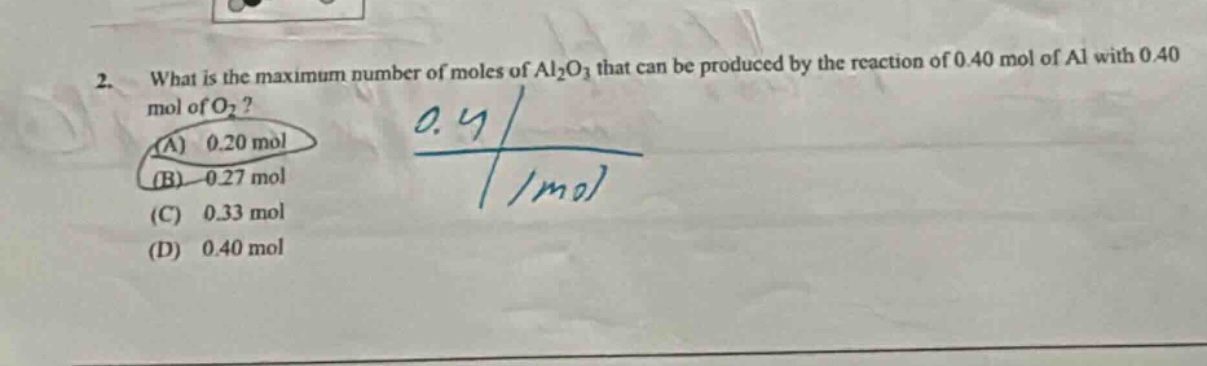
2. what is the maximum number of moles of al₂o₃ that can be produced by the reaction of 0.40 mol of al with 0.40 mol of o₂? (a) 0.20 mol (b) 0.27 mol (c) 0.33 mol (d) 0.40 mol
Answer
Explanation:
Step1: Write the balanced chemical equation.
The reaction between aluminum (Al) and oxygen ($O_2$) produces aluminum oxide ($Al_2O_3$). The balanced equation is: $$4Al + 3O_2 \rightarrow 2Al_2O_3$$
Step2: Calculate moles of $Al_2O_3$ produced from Al.
Using the stoichiometry from the balanced equation (4 mol Al produces 2 mol $Al_2O_3$): $$0.40 , \text{mol Al} \times \frac{2 , \text{mol} , Al_2O_3}{4 , \text{mol Al}} = 0.20 , \text{mol} , Al_2O_3$$
Step3: Calculate moles of $Al_2O_3$ produced from $O_2$.
Using the stoichiometry from the balanced equation (3 mol $O_2$ produces 2 mol $Al_2O_3$): $$0.40 , \text{mol} , O_2 \times \frac{2 , \text{mol} , Al_2O_3}{3 , \text{mol} , O_2} \approx 0.267 , \text{mol} , Al_2O_3$$
Step4: Identify the limiting reactant and maximum product.
Compare the moles of $Al_2O_3$ produced from each reactant. Aluminum (Al) produces fewer moles (0.20 mol) than oxygen ($O_2$) (0.267 mol). Therefore, Al is the limiting reactant, and the maximum amount of $Al_2O_3$ that can be produced is 0.20 mol.
Answer:
A. 0.20 mol