mercury(ii) oxide (hgo) decomposes to form mercury (hg) and oxygen (o₂). the balanced chemical equation is…
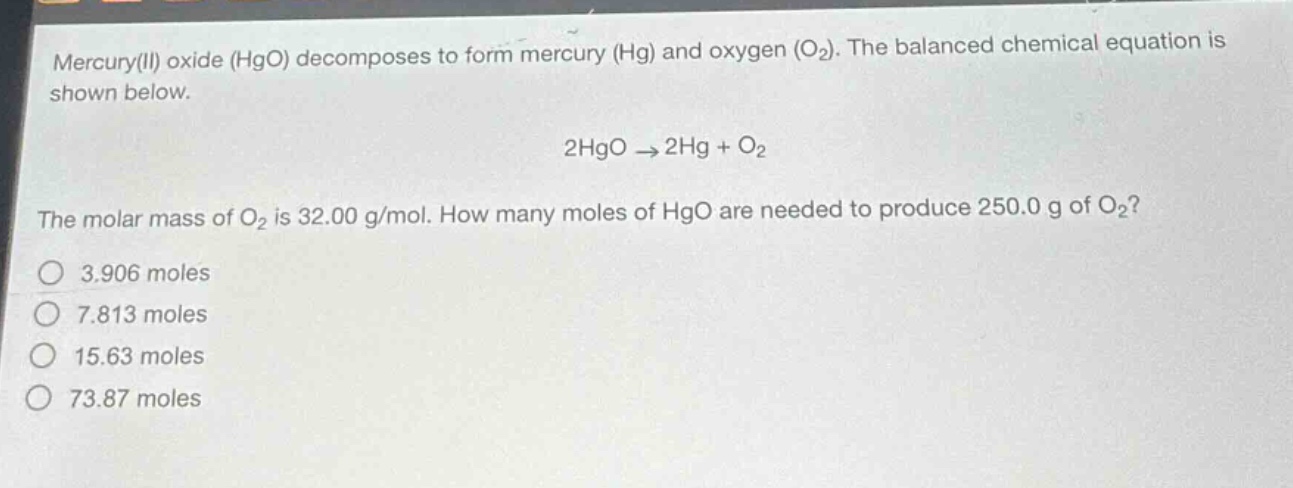
mercury(ii) oxide (hgo) decomposes to form mercury (hg) and oxygen (o₂). the balanced chemical equation is shown below.\n2hgo → 2hg + o₂\nthe molar mass of o₂ is 32.00 g/mol. how many moles of hgo are needed to produce 250.0 g of o₂?\no 3.906 moles\no 7.813 moles\no 15.63 moles\no 73.87 moles
Answer
Explanation:
Step1: Calculate moles of O₂
Use the formula $n=\frac{m}{M}$, where $n$ is moles, $m$ is mass, and $M$ is molar - mass. Given $m = 250.0\ g$ and $M = 32.00\ g/mol$. $n_{O_2}=\frac{250.0\ g}{32.00\ g/mol}=7.8125\ mol$
Step2: Determine moles of HgO from mole - ratio
From the balanced equation $2HgO\rightarrow2Hg + O_2$, the mole - ratio of $HgO$ to $O_2$ is $2:1$. So, $n_{HgO}=2\times n_{O_2}$. $n_{HgO}=2\times7.8125\ mol = 15.625\ mol\approx15.63\ mol$
Answer:
15.63 moles