a model for reaction rates exit ticket\nfor the chemical reaction system described in the diagram, what can…
a model for reaction rates exit ticket\nfor the chemical reaction system described in the diagram, what can you conclude about the magnitude of the activation energy with respect to reaction direction?\nthe reaction is endothermic because the products would be at a lower energy state than the reactants.\nthe reaction is exothermic because the products would be at a lower energy state than the reactants.\nthe reaction is exothermic because reactants need to absorb energy to become the products.\nthe reaction is endothermic because the activation energy is higher than the energy of the products.
Answer
Brief Explanations:
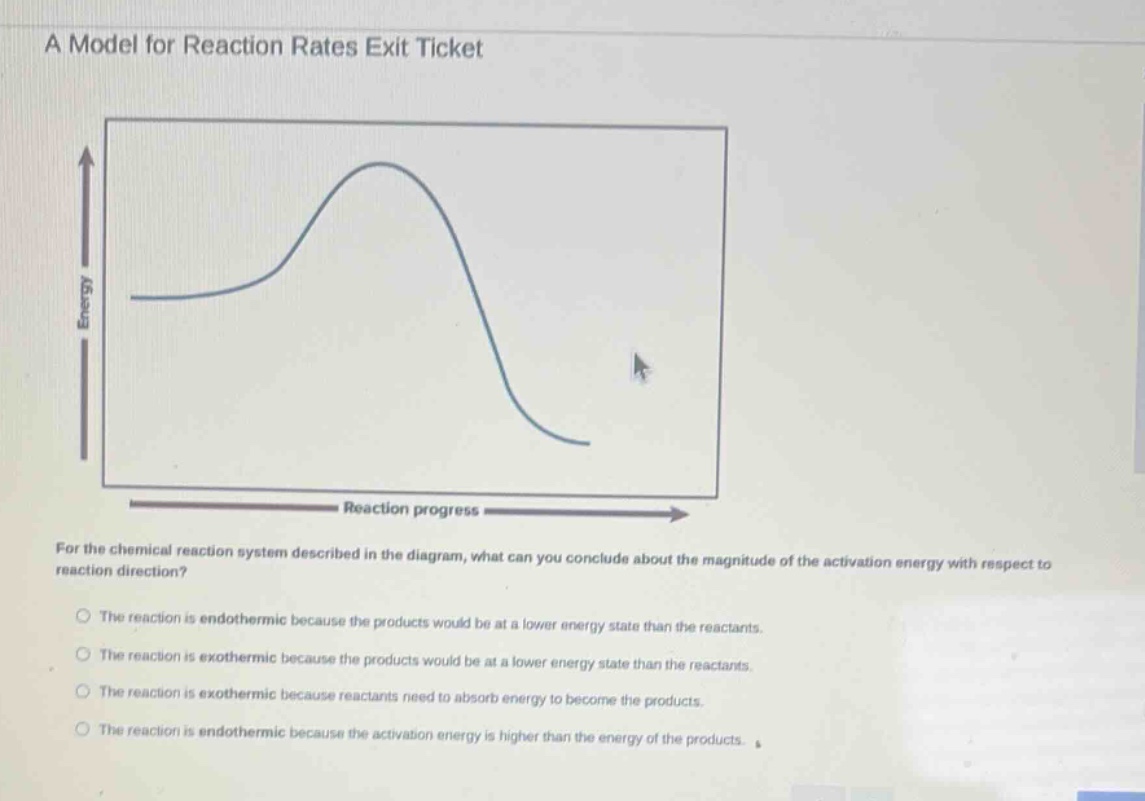
The provided diagram is an energy profile for a chemical reaction. The y-axis represents energy, and the x-axis represents the reaction progress.
- Reactant and Product Energies: The initial flat line on the left represents the energy of the reactants. The final flat line on the right represents the energy of the products. In this diagram, the energy level of the products is lower than the energy level of the reactants.
- Exothermic vs. Endothermic Reactions:
- An exothermic reaction is a reaction that releases energy, resulting in products having lower energy than the reactants.
- An endothermic reaction is a reaction that absorbs energy, resulting in products having higher energy than the reactants. Since the products are at a lower energy state than the reactants in the given diagram, the reaction is exothermic.
- Activation Energy: The peak in the curve represents the transition state. The activation energy ($E_a$) is the minimum energy required for the reaction to occur, which is the difference in energy between the reactants and the transition state. While the diagram shows an activation energy, its magnitude relative to other quantities (like product energy) doesn't define whether a reaction is endothermic or exothermic. The overall energy change ($\Delta H = E_{products} - E_{reactants}$) determines this.
Analyzing the options:
- "The reaction is endothermic because the products would be at a lower energy state than the reactants." This is incorrect. If products are at a lower energy state, the reaction is exothermic.
- "The reaction is exothermic because the products would be at a lower energy state than the reactants." This statement is correct. The diagram shows products at a lower energy level than reactants, which is characteristic of an exothermic reaction.
- "The reaction is exothermic because reactants need to absorb energy to become the products." While reactants do absorb activation energy to reach the transition state, this is true for both endothermic and exothermic reactions. The defining characteristic of an exothermic reaction is the net release of energy, meaning products are at a lower energy state.
- "The reaction is endothermic because the activation energy is higher than the energy of the products." This is incorrect. The reaction is exothermic as established. Furthermore, comparing activation energy to the energy of products is not the criterion for determining if a reaction is endothermic or exothermic.
Therefore, the most accurate conclusion based on the diagram is that the reaction is exothermic because the products are at a lower energy state than the reactants.
Answer:
The reaction is exothermic because the products would be at a lower energy state than the reactants.