multiple choice questions\n1. what happens to solvation as temperature increases?\na) decreases\nb)…
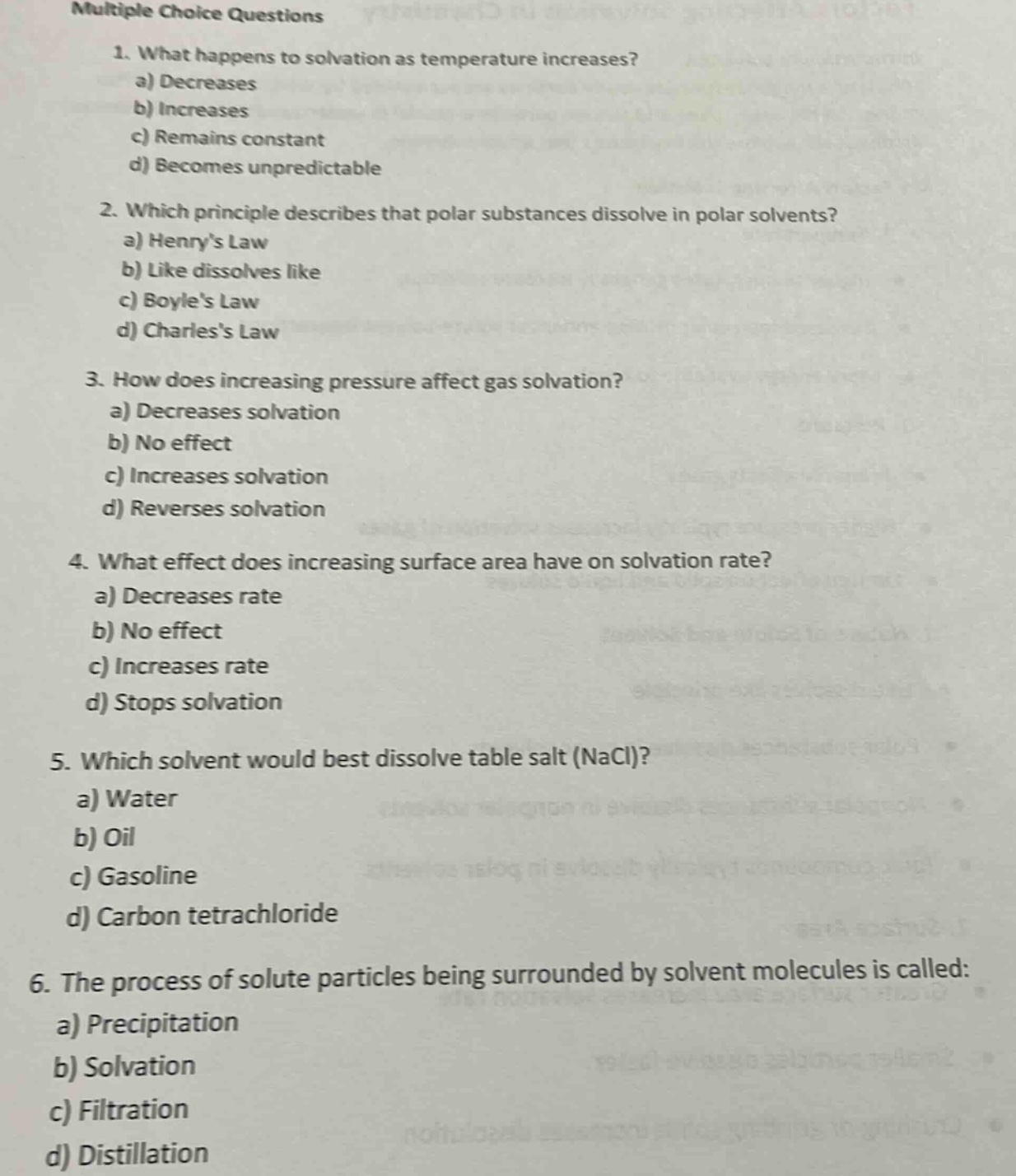
multiple choice questions\n1. what happens to solvation as temperature increases?\na) decreases\nb) increases\nc) remains constant\nd) becomes unpredictable\n2. which principle describes that polar substances dissolve in polar solvents?\na) henrys law\nb) like dissolves like\nc) boyles law\nd) charless law\n3. how does increasing pressure affect gas solvation?\na) decreases solvation\nb) no effect\nc) increases solvation\nd) reverses solvation\n4. what effect does increasing surface area have on solvation rate?\na) decreases rate\nb) no effect\nc) increases rate\nd) stops solvation\n5. which solvent would best dissolve table salt (nacl)?\na) water\nb) oil\nc) gasoline\nd) carbon tetrachloride\n6. the process of solute particles being surrounded by solvent molecules is called:\na) precipitation\nb) solvation\nc) filtration\nd) distillation
Answer
Brief Explanations:
- For the first question, as temperature increases, the kinetic energy of solvent and solute molecules increases, often causing solvation to decrease for many systems.
- The principle that polar substances dissolve in polar solvents is "like dissolves like". Henry's Law relates gas solubility to pressure, Boyle's Law is about pressure - volume relationship of gases, and Charles's Law is about volume - temperature relationship of gases.
- Increasing pressure increases gas solvation as more gas molecules are forced into the solvent.
- Increasing surface area provides more contact between solute and solvent, thus increasing the solvation rate.
- Table salt (NaCl) is an ionic compound. Water is a polar solvent and can effectively dissolve ionic compounds due to its ability to interact with ions through ion - dipole forces. Oil, gasoline, and carbon tetrachloride are non - polar solvents and cannot dissolve ionic compounds well.
- The process of solute particles being surrounded by solvent molecules is called solvation. Precipitation is the formation of a solid from a solution, filtration is a separation technique, and distillation is a separation method based on boiling points.
Answer:
- a) Decreases
- b) Like dissolves like
- c) Increases solvation
- c) Increases rate
- a) Water
- b) Solvation