2. name the following compounds.\na. cui\nb. feo\nc. zn(clo₃)₂\nd. pcl₅\ne. ca(hco₃)₂\nf. cl₄\ng. pbr₃
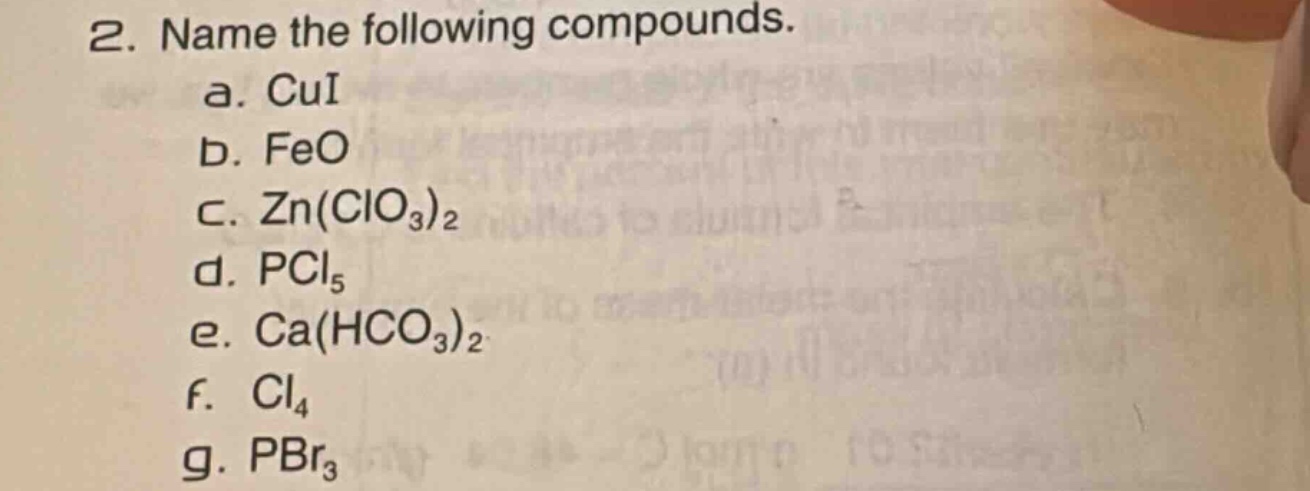
2. name the following compounds.\na. cui\nb. feo\nc. zn(clo₃)₂\nd. pcl₅\ne. ca(hco₃)₂\nf. cl₄\ng. pbr₃
Answer
Explanation:
Step1: Identify cation and anion for ionic compounds
For ionic compounds, name the cation first and then the anion. For transition - metals, indicate the oxidation state in Roman numerals.
Step2: Name binary molecular compounds
For binary molecular compounds, use prefixes to indicate the number of atoms of each element.
a. CuI
Copper(I) iodide. Copper is a transition - metal with a + 1 oxidation state here and iodide is the anion.
b. FeO
Iron(II) oxide. Iron is a transition - metal with a + 2 oxidation state here and oxide is the anion.
c. Zn(ClO₃)₂
Zinc chlorate. Zinc is the cation and chlorate ($ClO_3^-$) is the poly - atomic anion.
d. PCl₅
Phosphorus pentachloride. It is a binary molecular compound. The prefix "penta -" is used for 5 chlorine atoms.
e. Ca(HCO₃)₂
Calcium hydrogen carbonate or calcium bicarbonate. Calcium is the cation and hydrogen carbonate ($HCO_3^-$) is the poly - atomic anion.
f. CCl₄
Carbon tetrachloride. It is a binary molecular compound. The prefix "tetra -" is used for 4 chlorine atoms.
g. PBr₃
Phosphorus tribromide. It is a binary molecular compound. The prefix "tri -" is used for 3 bromine atoms.
Answer:
a. Copper(I) iodide b. Iron(II) oxide c. Zinc chlorate d. Phosphorus pentachloride e. Calcium hydrogen carbonate (or calcium bicarbonate) f. Carbon tetrachloride g. Phosphorus tribromide