name\nmatter\ndirections: determine if the statements are true or false. circle the answer and color the…
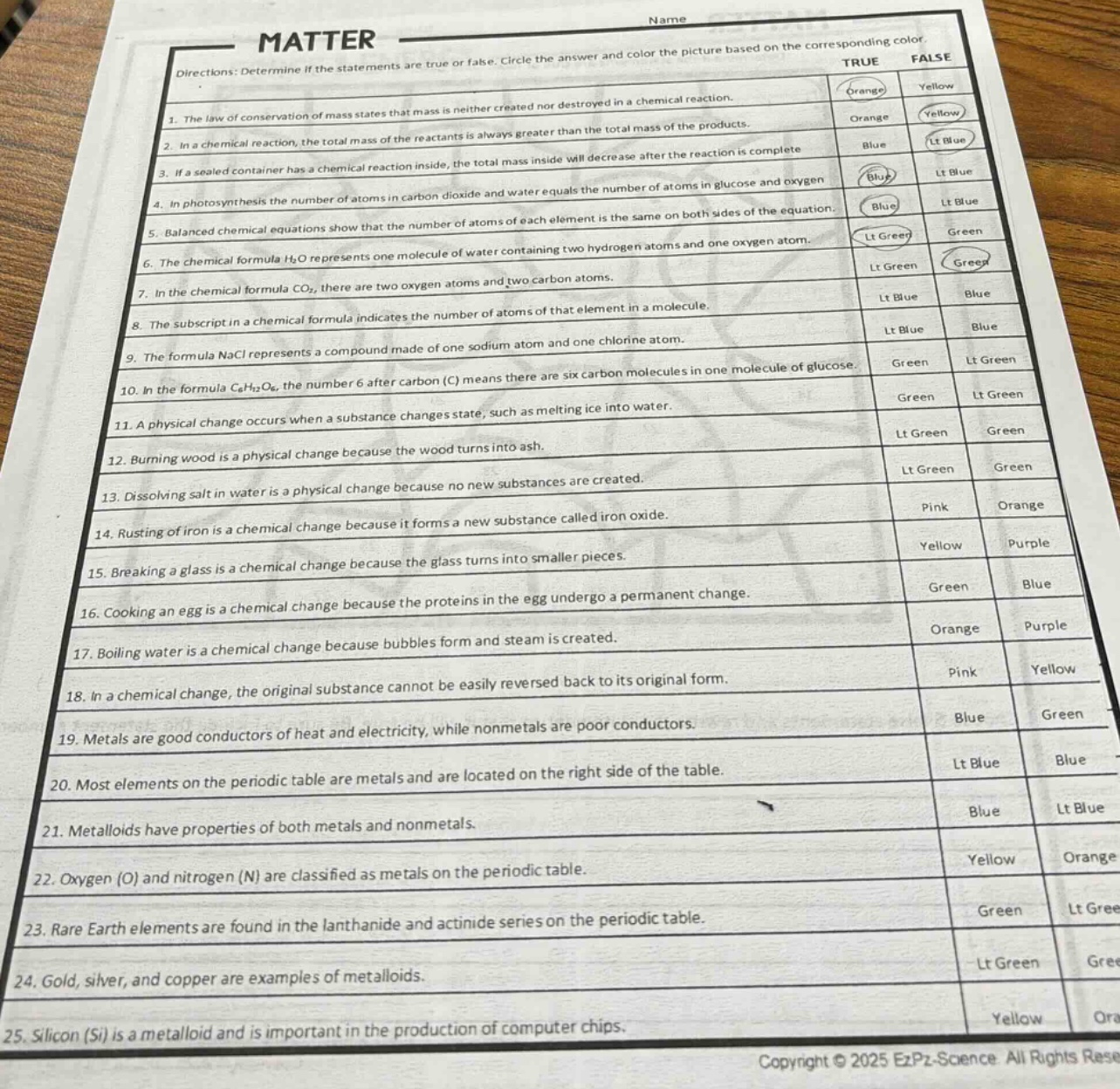
name\nmatter\ndirections: determine if the statements are true or false. circle the answer and color the picture based on the corresponding color.\n1. the law of conservation of mass states that mass is neither created nor destroyed in a chemical reaction.\n2. in a chemical reaction, the total mass of the reactants is always greater than the total mass of the products.\n3. if a sealed container has a chemical reaction inside, the total mass inside will decrease after the reaction is complete.\n4. in photosynthesis the number of atoms in carbon dioxide and water equals the number of atoms in glucose and oxygen.\n5. balanced chemical equations show that the number of atoms of each element is the same on both sides of the equation.\n6. the chemical formula h₂o represents one molecule of water containing two hydrogen atoms and one oxygen atom.\n7. in the chemical formula co₂, there are two oxygen atoms and two carbon atoms.\n8. the subscript in a chemical formula indicates the number of atoms of that element in a molecule.\n9. the formula nacl represents a compound made of one sodium atom and one chlorine atom.\n10. in the formula c₆h₁₂o₆, the number 6 after carbon (c) means there are six carbon molecules in one molecule of glucose.\n11. a physical change occurs when a substance changes state, such as melting ice into water.\n12. burning wood is a physical change because the wood turns into ash.\n13. dissolving salt in water is a physical change because no new substances are created.\n14. rusting of iron is a chemical change because it forms a new substance called iron oxide.\n15. breaking a glass is a chemical change because the glass turns into smaller pieces.\n16. cooking an egg is a chemical change because the proteins in the egg undergo a permanent change.\n17. boiling water is a chemical change because bubbles form and steam is created.\n18. in a chemical change, the original substance cannot be easily reversed back to its original form.\n19. metals are good conductors of heat and electricity, while nonmetals are poor conductors.\n20. most elements on the periodic table are metals and are located on the right side of the table.\n21. metalloids have properties of both metals and nonmetals.\n22. oxygen (o) and nitrogen (n) are classified as metals on the periodic table.\n23. rare earth elements are found in the lanthanide and actinide series on the periodic table.\n24. gold, silver, and copper are examples of metalloids.\n25. silicon (si) is a metalloid and is important in the production of computer chips.\ntrue\tfalse\norange\tyellow\norange\tyellow\nblue\tlt blue\nblue\tlt blue\nblue\tlt blue\nlt green\tgreen\nlt green\tgreen\nlt blue\tblue\nlt blue\tblue\ngreen\tlt green\nlt green\tgreen\nlt green\tgreen\npink\torange\nyellow\tpurple\ngreen\tblue\norange\tpurple\npink\tyellow\nblue\tgreen\nlt blue\tblue\nblue\tlt blue\nyellow\torange\ngreen\tlt green\nlt green\tgreen\nyellow\tora\ncopyright © 2025 ezpz - science. all rights reserved.
Answer
Brief Explanations:
- The law of conservation of mass indeed states mass is conserved in chemical reactions - True.
- Total mass of reactants equals total mass of products - False.
- In a sealed - container reaction, mass is conserved - False.
- In photosynthesis, atoms are conserved but not equal in number as stated - False.
- Balanced equations have equal atoms of each element on both sides - True.
- $H_2O$ has 2 hydrogen and 1 oxygen atom - True.
- $CO_2$ has 2 oxygen and 1 carbon atom - False.
- Subscripts indicate number of atoms in a molecule - True.
- $NaCl$ is one sodium and one chlorine atom - True.
- In $C_6H_{12}O_6$, 6 is number of carbon atoms not molecules - False.
- State - change like melting ice is physical change - True.
- Burning wood is chemical change - False.
- Dissolving salt is physical change - True.
- Rusting is chemical change - True.
- Breaking glass is physical change - False.
- Cooking egg is chemical change - True.
- Boiling water is physical change - False.
- Chemical changes are hard to reverse - True.
- Metals are good conductors, non - metals are poor - True.
- Most metals are on left side of periodic table - False.
- Metalloids have properties of both - True.
- Oxygen and nitrogen are non - metals - False.
- Rare Earth elements in lanthanide and actinide series - True.
- Gold, silver, copper are metals not metalloids - False.
- Silicon is a metalloid important for computer chips - True.
Answer:
- True
- False
- False
- False
- True
- True
- False
- True
- True
- False
- True
- False
- True
- True
- False
- True
- False
- True
- True
- False
- True
- False
- True
- False
- True