for each nonmetal below, identify how many covalent bonds (shared electron pairs) it forms with other atoms…
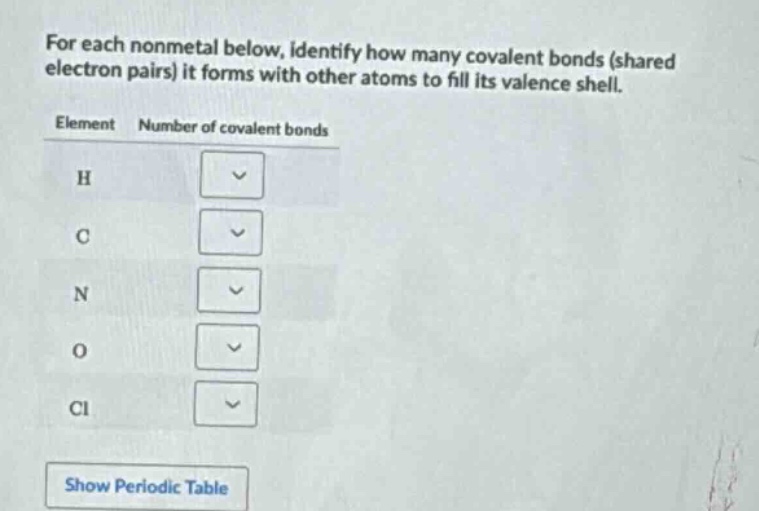
for each nonmetal below, identify how many covalent bonds (shared electron pairs) it forms with other atoms to fill its valence shell.\nelement number of covalent bonds\nh\nc\nn\no\ncl\nshow periodic table
Answer
Explanation:
The number of covalent bonds a nonmetal typically forms is determined by the number of electrons needed to complete its valence shell (usually 8 electrons, following the octet rule, except for Hydrogen which follows the duet rule, needing 2 electrons). Each covalent bond involves sharing one electron from the atom.
Step 1: Determine bonds for Hydrogen (H)
Hydrogen has 1 valence electron and needs 2 electrons to fill its shell (duet rule). $$ \text{Bonds} = 2 - 1 = 1 $$
Step 2: Determine bonds for Carbon (C)
Carbon has 4 valence electrons and needs 8 electrons to fill its shell (octet rule). $$ \text{Bonds} = 8 - 4 = 4 $$
Step 3: Determine bonds for Nitrogen (N)
Nitrogen has 5 valence electrons and needs 8 electrons to fill its shell (octet rule). $$ \text{Bonds} = 8 - 5 = 3 $$
Step 4: Determine bonds for Oxygen (O)
Oxygen has 6 valence electrons and needs 8 electrons to fill its shell (octet rule). $$ \text{Bonds} = 8 - 6 = 2 $$
Step 5: Determine bonds for Chlorine (Cl)
Chlorine has 7 valence electrons and needs 8 electrons to fill its shell (octet rule). $$ \text{Bonds} = 8 - 7 = 1 $$
Answer:
| Element | Number of covalent bonds |
|---|---|
| H | 1 |
| C | 4 |
| N | 3 |
| O | 2 |
| Cl | 1 |