which nucleophile was used in the following reaction?\n?\n$\\text{ch}_3\\text{ch}_2\\text{ch}_2\\text{mgbr}$\…
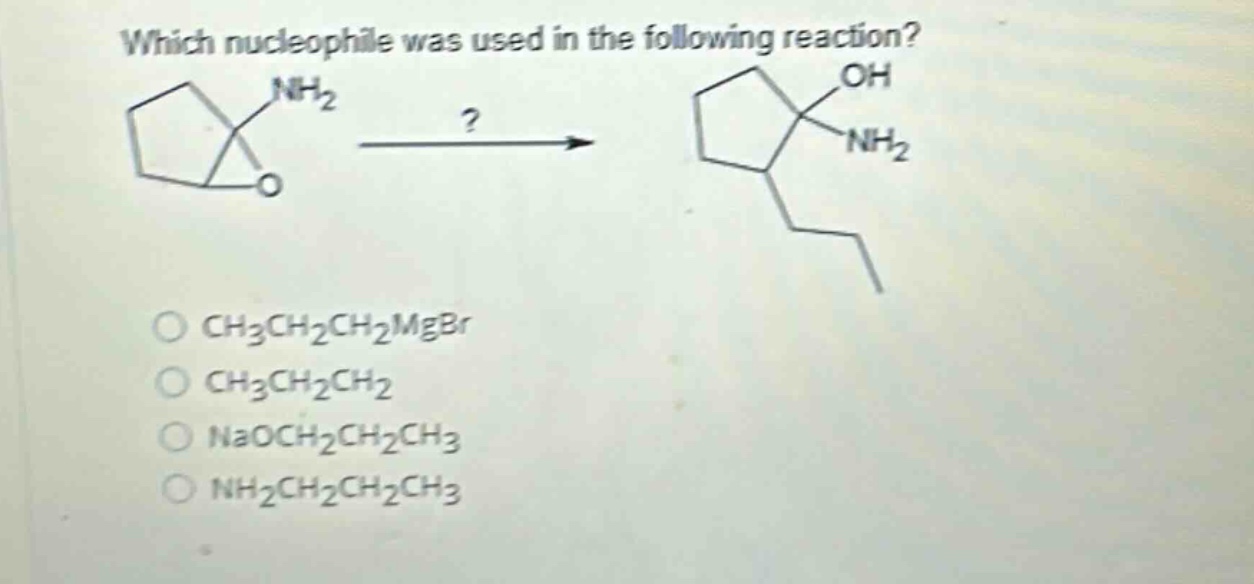
which nucleophile was used in the following reaction?\n?\n$\\text{ch}_3\\text{ch}_2\\text{ch}_2\\text{mgbr}$\n$\\text{ch}_3\\text{ch}_2\\text{ch}_2$\n$\\text{naoch}_2\\text{ch}_2\\text{ch}_3$\n$\\text{nh}_2\\text{ch}_2\\text{ch}_2\\text{ch}_3$
Answer
Brief Explanations:
A nucleophile is a species that donates an electron - pair to an electrophile to form a chemical bond. In this reaction, we need to identify which of the given species can act as a nucleophile to cause the transformation. Grignard reagents ($\ce{CH3CH2CH2MgBr}$) are strong nucleophiles. The $\ce{CH3CH2CH2 -}$ group in $\ce{CH3CH2CH2MgBr}$ can attack the electrophilic carbon in the starting compound. The other options either do not have a suitable nucleophilic site (e.g., $\ce{CH3CH2CH2}$ is not a stable species on its own in this context) or have different reactivity patterns. $\ce{NaOCH2CH2CH3}$ is a base and a nucleophile but its reactivity pattern is different from what is required here, and $\ce{NH2CH2CH2CH3}$ is more of a base and a weak nucleophile in comparison to the Grignard reagent for this type of reaction.
Answer:
A. $\ce{CH3CH2CH2MgBr}$