numerical atoms\nanswer the questions below. the circled number will form part of your code.\na what is the…
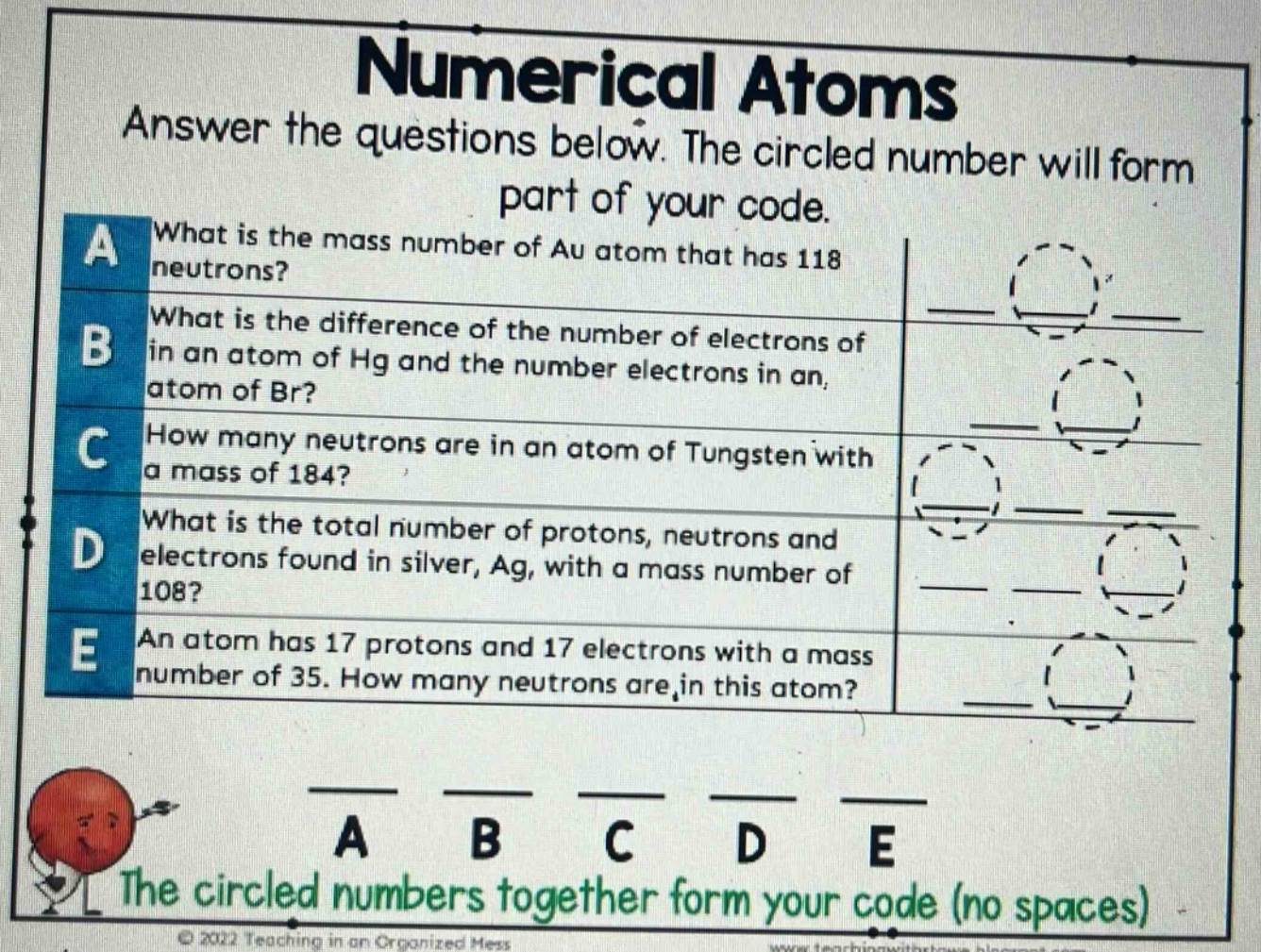
numerical atoms\nanswer the questions below. the circled number will form part of your code.\na what is the mass number of au atom that has 118 neutrons?\nb what is the difference of the number of electrons of in an atom of hg and the number electrons in an atom of br?\nc how many neutrons are in an atom of tungsten with a mass of 184?\nd what is the total number of protons, neutrons and electrons found in silver, ag, with a mass number of 108?\ne an atom has 17 protons and 17 electrons with a mass number of 35. how many neutrons are in this atom?\na b c d e\nthe circled numbers together form your code (no spaces)
Answer
Explanation:
Step1: Find mass number of Au
The atomic number of Au (gold) is 79. Mass number = number of protons+number of neutrons. So mass number = 79 + 118 = 197.
Step2: Find electron - number difference between Hg and Br
The atomic number of Hg (mercury) is 80, so number of electrons in neutral Hg is 80. The atomic number of Br (bromine) is 35, so number of electrons in neutral Br is 35. Difference = 80 - 35 = 45.
Step3: Find neutrons in tungsten
The atomic number of tungsten (W) is 74. Given mass number is 184. Number of neutrons=mass number - atomic number = 184 - 74 = 110.
Step4: Find total particles in silver
The atomic number of Ag (silver) is 47. Given mass number is 108. Number of neutrons = 108 - 47 = 61. In a neutral atom, number of electrons = number of protons = 47. Total number of protons + neutrons+electrons = 47+61 + 47 = 155.
Step5: Find neutrons in given atom
Given mass number is 35 and number of protons is 17. Number of neutrons=mass number - number of protons = 35 - 17 = 18.
Answer:
1974511015518