open - ended questions: answer the following questions in complete sentences.\n1. explain, using the…
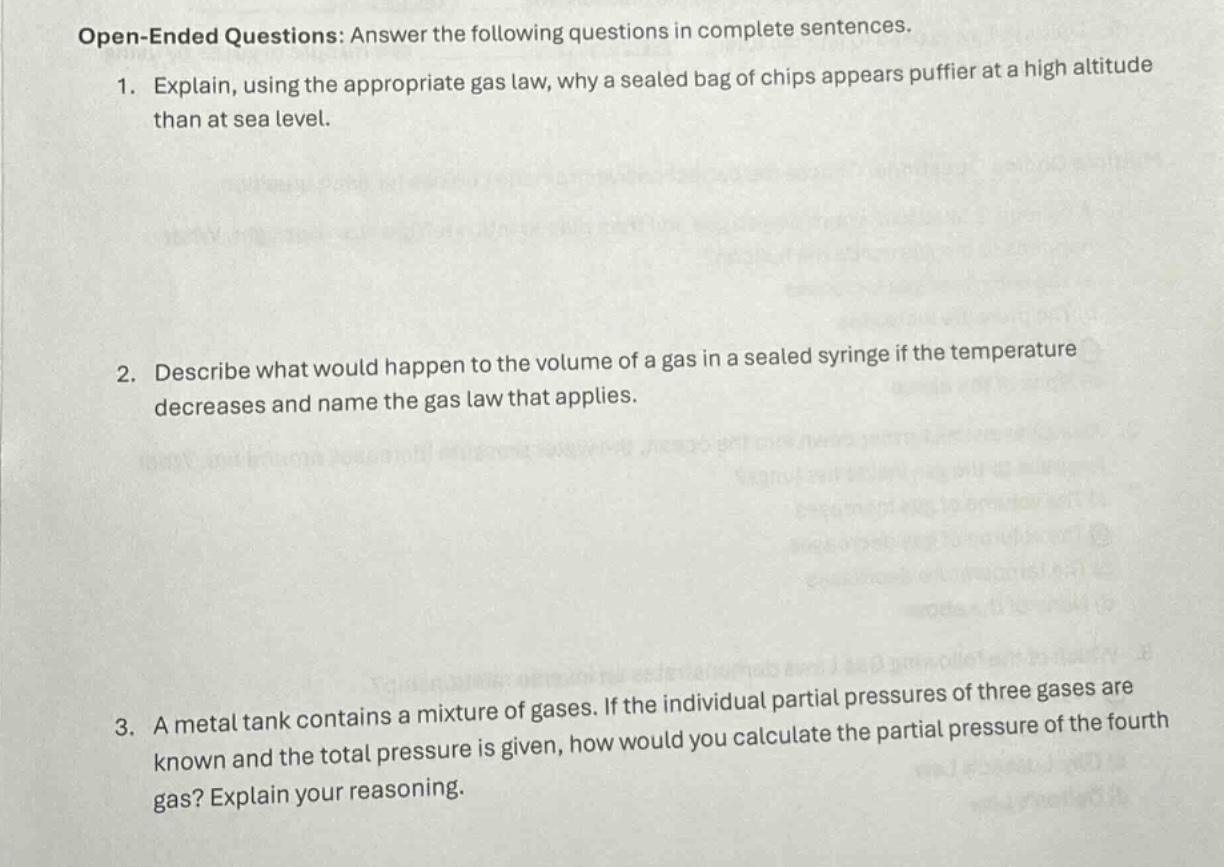
open - ended questions: answer the following questions in complete sentences.\n1. explain, using the appropriate gas law, why a sealed bag of chips appears puffier at a high altitude than at sea level.\n2. describe what would happen to the volume of a gas in a sealed syringe if the temperature decreases and name the gas law that applies.\n3. a metal tank contains a mixture of gases. if the individual partial pressures of three gases are known and the total pressure is given, how would you calculate the partial pressure of the fourth gas? explain your reasoning.
Answer
Explanation:
Question 1
Step1: Identify the gas law
Boyle's law ($P_1V_1 = P_2V_2$) applies as temperature is assumed constant.
Step2: Analyze pressure - volume relationship
At high altitude, external pressure ($P_2$) is lower than at sea - level ($P_1$). For a sealed bag of chips, the gas inside has a relatively constant amount. According to Boyle's law, when $P_2<P_1$, $V_2 > V_1$, so the bag appears puffier.
Question 2
Step1: Identify the gas law
Charles's law ($\frac{V_1}{T_1}=\frac{V_2}{T_2}$) applies as pressure is assumed constant for a sealed syringe.
Step2: Analyze temperature - volume relationship
When the temperature ($T$) decreases, according to Charles's law, since $T_2 < T_1$, $V_2<V_1$. So the volume of the gas in the sealed syringe decreases.
Question 3
Step1: Recall Dalton's law of partial pressures
Dalton's law states that $P_{total}=P_1 + P_2+P_3 + P_4$.
Step2: Calculate the fourth partial pressure
We can rearrange the formula to find $P_4=P_{total}-(P_1 + P_2+P_3)$. The total pressure of a gas mixture is the sum of the partial pressures of its component gases, so subtracting the sum of the known partial pressures from the total pressure gives the partial pressure of the fourth gas.
Answer:
- At high altitude, the external pressure is lower than at sea - level. According to Boyle's law ($P_1V_1 = P_2V_2$), with the amount of gas inside the sealed bag of chips relatively constant, when the external pressure decreases, the volume of the gas inside the bag increases, making the bag appear puffier.
- When the temperature of the gas in a sealed syringe decreases, according to Charles's law ($\frac{V_1}{T_1}=\frac{V_2}{T_2}$), the volume of the gas decreases.
- According to Dalton's law of partial pressures ($P_{total}=P_1 + P_2+P_3 + P_4$), we can calculate the partial pressure of the fourth gas as $P_4=P_{total}-(P_1 + P_2+P_3)$ because the total pressure of a gas mixture is the sum of the partial pressures of its component gases.