what is oxidized and what is reduced in this reaction?\nn₂h₄(l) + 2h₂o₂(l) → n₂(g) + 4h₂o(g)\no n is reduced…
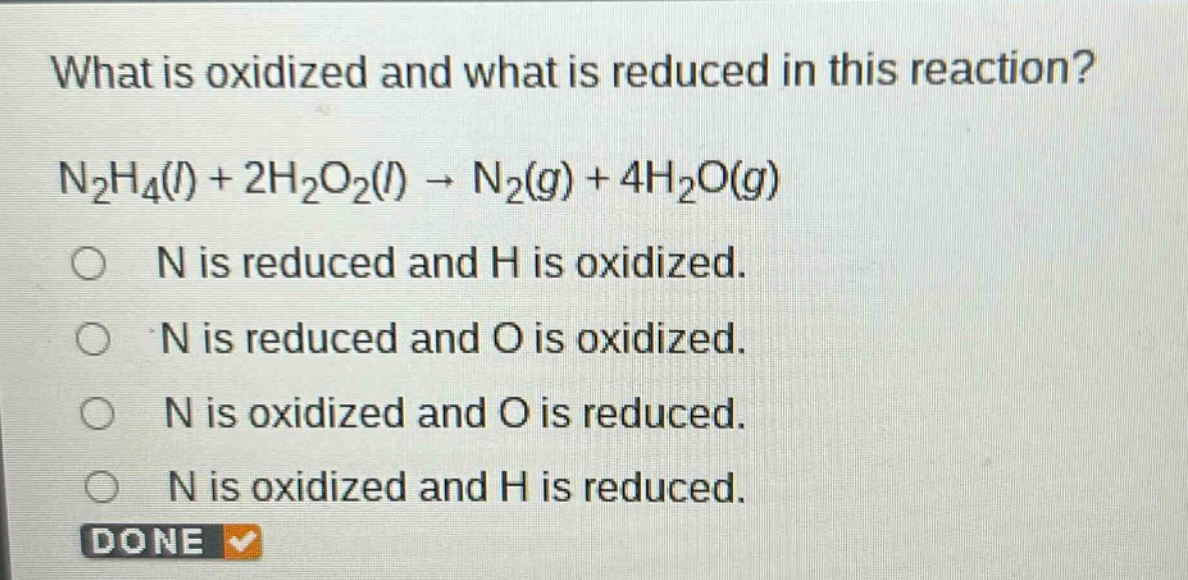
what is oxidized and what is reduced in this reaction?\nn₂h₄(l) + 2h₂o₂(l) → n₂(g) + 4h₂o(g)\no n is reduced and h is oxidized.\no n is reduced and o is oxidized.\no n is oxidized and o is reduced.\no n is oxidized and h is reduced.\ndone
Answer
Explanation:
Step1: Determine oxidation - state of N in N₂H₄
In N₂H₄, hydrogen has an oxidation - state of + 1. Let the oxidation - state of N be (x). Using the rule that the sum of oxidation states in a neutral compound is 0, for N₂H₄: (2x+4\times( + 1)=0), solving for (x) gives (x=-2).
Step2: Determine oxidation - state of N in N₂
In elemental nitrogen N₂, the oxidation - state of N is 0.
Step3: Determine oxidation - state of O in H₂O₂
In H₂O₂, hydrogen has an oxidation - state of + 1. Let the oxidation - state of O be (y). Using the rule that the sum of oxidation states in a neutral compound is 0, for H₂O₂: (2\times( + 1)+2y = 0), solving for (y) gives (y=-1).
Step4: Determine oxidation - state of O in H₂O
In H₂O, hydrogen has an oxidation - state of + 1. Let the oxidation - state of O be (z). Using the rule that the sum of oxidation states in a neutral compound is 0, for H₂O: (2\times( + 1)+z = 0), solving for (z) gives (z=-2).
Step5: Analyze oxidation and reduction
The oxidation state of N changes from - 2 in N₂H₄ to 0 in N₂. An increase in oxidation state means oxidation. The oxidation state of O changes from - 1 in H₂O₂ to - 2 in H₂O. A decrease in oxidation state means reduction.
Answer:
N is oxidized and O is reduced.