oxygen is acting as an oxidizing agent in all of the following reactions except\n\na. $2\\text{c(s)} +…
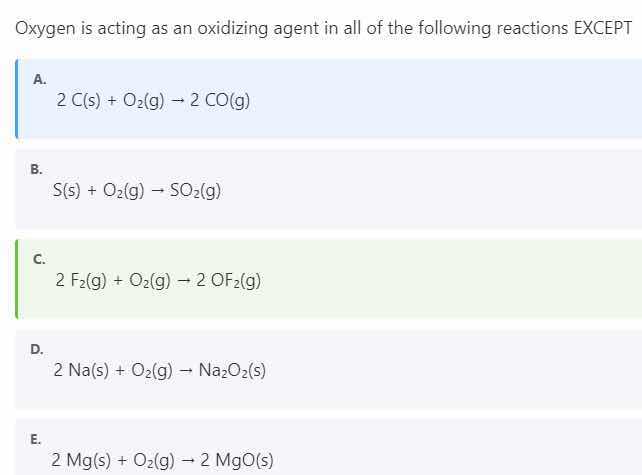
oxygen is acting as an oxidizing agent in all of the following reactions except\n\na. $2\\text{c(s)} + \\text{o}_2\\text{(g)} \\rightarrow 2\\text{co(g)}$\nb. $\\text{s(s)} + \\text{o}_2\\text{(g)} \\rightarrow \\text{so}_2\\text{(g)}$\nc. $2\\text{f}_2\\text{(g)} + \\text{o}_2\\text{(g)} \\rightarrow 2\\text{of}_2\\text{(g)}$\nd. $2\\text{na(s)} + \\text{o}_2\\text{(g)} \\rightarrow \\text{na}_2\\text{o}_2\\text{(s)}$\ne. $2\\text{mg(s)} + \\text{o}_2\\text{(g)} \\rightarrow 2\\text{mgo(s)}$
Answer
Explanation:
Step1: Define oxidizing agent
An oxidizing agent gains electrons and its oxidation state decreases.
Step2: Analyze reaction A
Carbon changes from $0$ to $+2$; Oxygen changes from $0$ to $-2$. Oxygen is an oxidizing agent. $$2\text{C}(s) + \text{O}_{2}(g) \rightarrow 2\text{CO}(g)$$
Step3: Analyze reaction B
Sulfur changes from $0$ to $+4$; Oxygen changes from $0$ to $-2$. Oxygen is an oxidizing agent. $$\text{S}(s) + \text{O}{2}(g) \rightarrow \text{SO}{2}(g)$$
Step4: Analyze reaction C
Fluorine is more electronegative than oxygen. Fluorine changes from $0$ to $-1$; Oxygen changes from $0$ to $+2$. Oxygen is oxidized, making it a reducing agent. $$2\text{F}{2}(g) + \text{O}{2}(g) \rightarrow 2\text{OF}_{2}(g)$$
Step5: Analyze reaction D
Sodium changes from $0$ to $+1$; Oxygen changes from $0$ to $-1$. Oxygen is an oxidizing agent. $$2\text{Na}(s) + \text{O}{2}(g) \rightarrow \text{Na}{2}\text{O}_{2}(s)$$
Step6: Analyze reaction E
Magnesium changes from $0$ to $+2$; Oxygen changes from $0$ to $-2$. Oxygen is an oxidizing agent. $$2\text{Mg}(s) + \text{O}_{2}(g) \rightarrow 2\text{MgO}(s)$$
Answer:
C. $2\text{F}{2}(g) + \text{O}{2}(g) \rightarrow 2\text{OF}_{2}(g)$