oxygen is acting as an oxidizing agent in all of the following reactions excepta.\\(\\ce{2 c(s) + o2(g) -> 2…
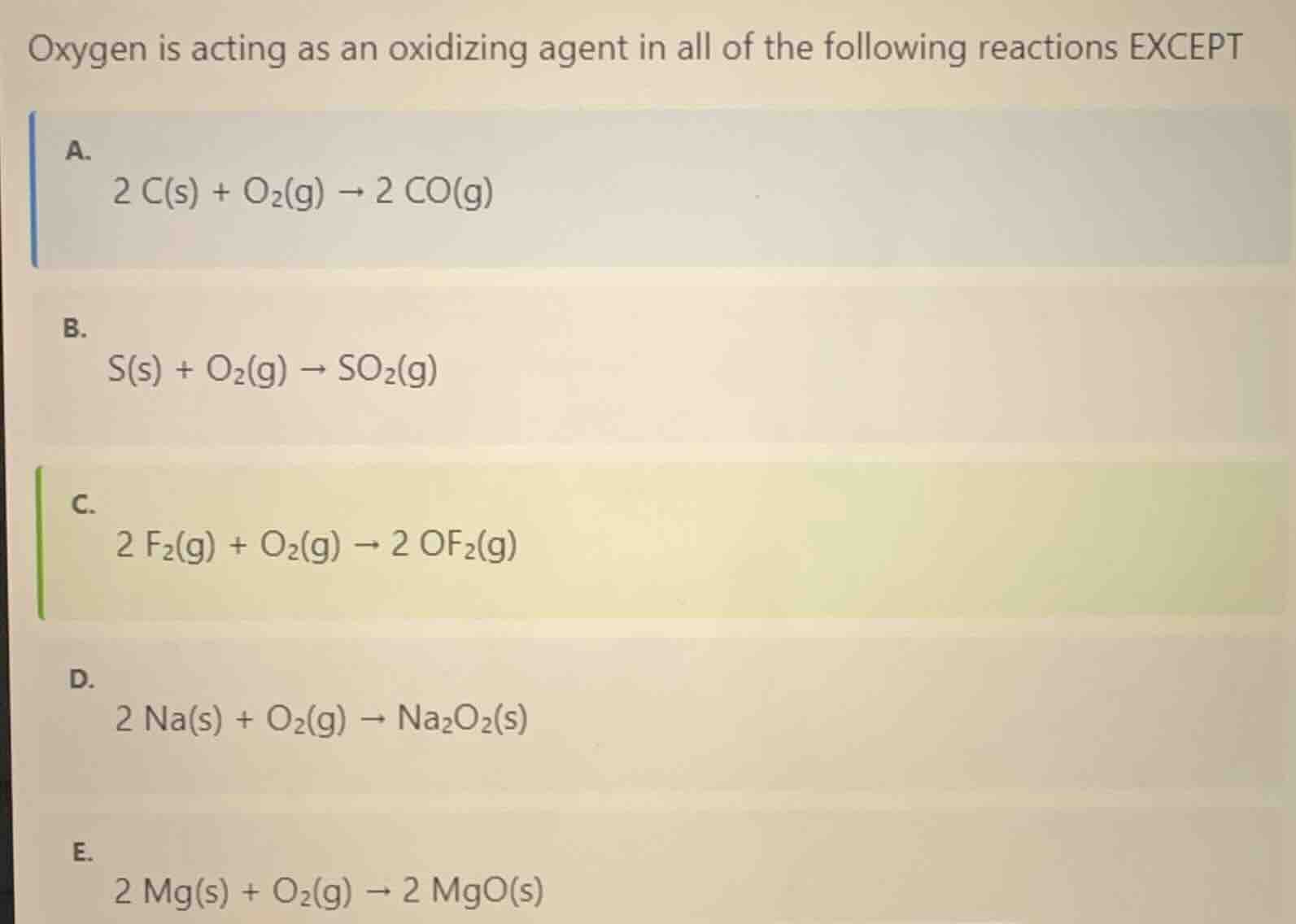
oxygen is acting as an oxidizing agent in all of the following reactions excepta.\\(\\ce{2 c(s) + o2(g) -> 2 co(g)}\\)b.\\(\\ce{s(s) + o2(g) -> so2(g)}\\)c.\\(\\ce{2 f2(g) + o2(g) -> 2 of2(g)}\\)d.\\(\\ce{2 na(s) + o2(g) -> na2o2(s)}\\)e.\\(\\ce{2 mg(s) + o2(g) -> 2 mgo(s)}\\)
Answer
Brief Explanations:
To determine when oxygen is not an oxidizing agent, we analyze the oxidation states:
- In an oxidizing agent, the element is reduced (oxidation state decreases).
- For option A: C goes from 0 to +2 (oxidized), O in (O_2) (0) goes to -2 (reduced) → (O_2) is oxidizing agent.
- For option B: S goes from 0 to +4 (oxidized), O in (O_2) (0) goes to -2 (reduced) → (O_2) is oxidizing agent.
- For option C: F in (F_2) (0) goes to -1 (reduced), O in (O_2) (0) goes to +2 (oxidized) → (O_2) is oxidized (acting as reducing agent), not oxidizing agent.
- For option D: Na goes from 0 to +1 (oxidized), O in (O_2) (0) goes to -1 (reduced) → (O_2) is oxidizing agent.
- For option E: Mg goes from 0 to +2 (oxidized), O in (O_2) (0) goes to -2 (reduced) → (O_2) is oxidizing agent.
Answer:
C. ( 2 F_2(g) + O_2(g) \rightarrow 2 OF_2(g) )