part ii: phet simulation\nhttp://phet.colorado.edu/en/simulations/category/html\nchoose concentration and…
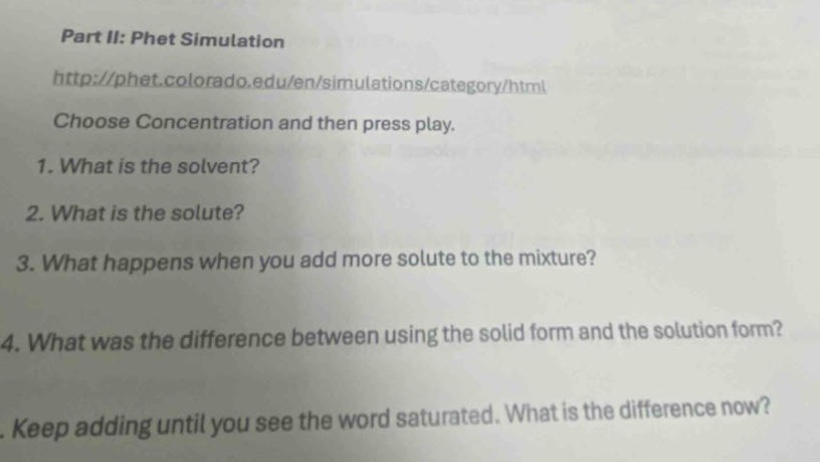
part ii: phet simulation\nhttp://phet.colorado.edu/en/simulations/category/html\nchoose concentration and then press play.\n1. what is the solvent?\n2. what is the solute?\n3. what happens when you add more solute to the mixture?\n4. what was the difference between using the solid form and the solution form?\n. keep adding until you see the word saturated. what is the difference now?
Answer
Brief Explanations:
- In a solution, the solvent is the substance that dissolves the solute. It is usually present in the largest amount.
- The solute is the substance that is dissolved in the solvent.
- When more solute is added to the mixture, the concentration of the solution increases. If the solution is not saturated, the additional solute will dissolve. If it is saturated, the excess solute will not dissolve and will settle at the bottom.
- The solid form of a substance may dissolve slowly in the solvent to form a solution. In solution form, the solute is already dispersed in the solvent, and reactions or interactions may occur more quickly as the particles are more mobile and have greater contact with other substances. When the solution becomes saturated, no more solute can dissolve at the given temperature and pressure. The undissolved solute remains in solid - like form in the solution, and the concentration of the dissolved solute remains constant.
Answer:
- The substance present in the largest amount that dissolves the solute.
- The substance that is dissolved in the solvent.
- Concentration increases; if saturated, excess solute doesn't dissolve.
- Solid may dissolve slowly; solution has more mobile particles; when saturated, undissolved solute remains and concentration is constant.