part 1 multiple choice: write the answer that best answers the question in the blank. (2 pts each)\n1. atoms…
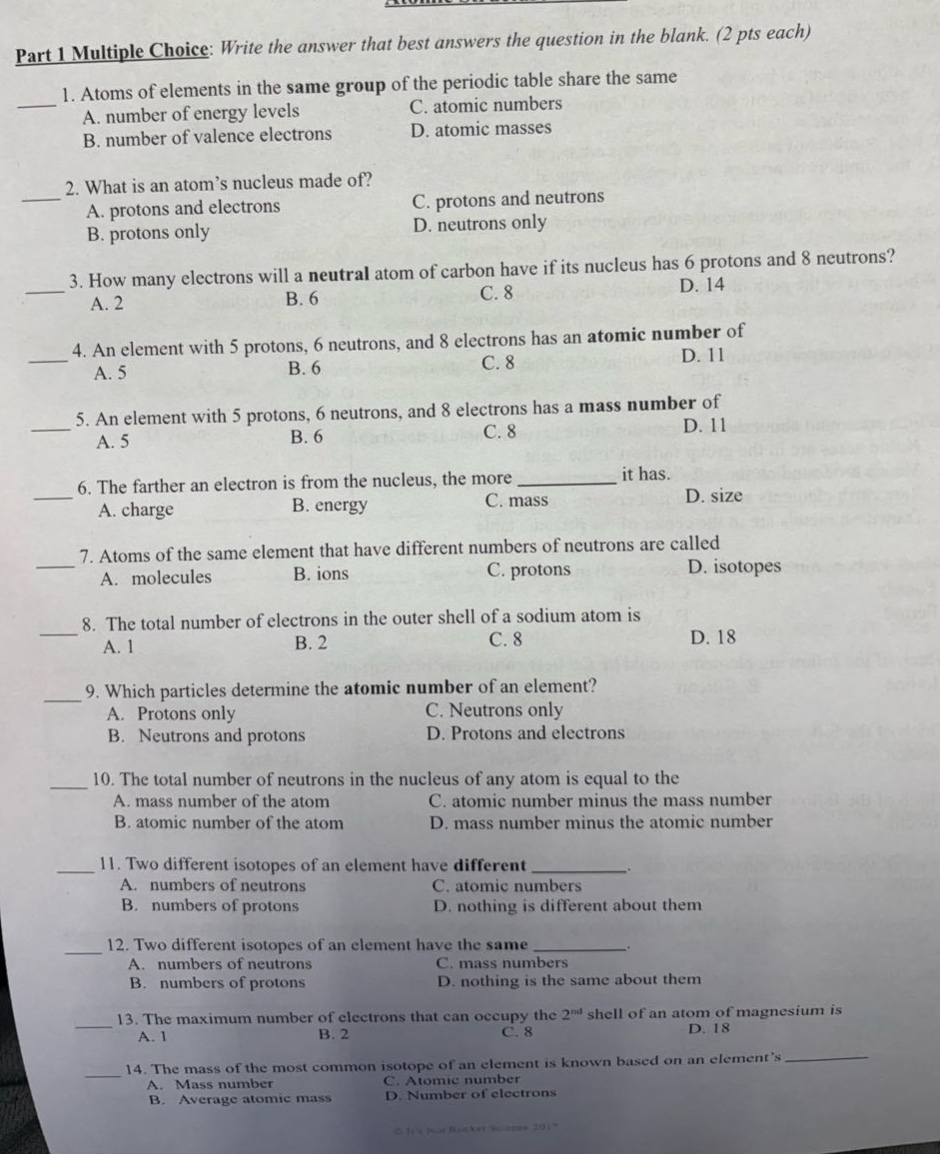
part 1 multiple choice: write the answer that best answers the question in the blank. (2 pts each)\n1. atoms of elements in the same group of the periodic table share the same\na. number of energy levels c. atomic numbers\nb. number of valence electrons d. atomic masses\n2. what is an atom’s nucleus made of?\na. protons and electrons c. protons and neutrons\nb. protons only d. neutrons only\n3. how many electrons will a neutral atom of carbon have if its nucleus has 6 protons and 8 neutrons?\na. 2 b. 6 c. 8 d. 14\n4. an element with 5 protons, 6 neutrons, and 8 electrons has an atomic number.\na. 5 b. 6 c. 8 d. 11\n5. an element with 5 protons, 6 neutrons, and 8 electrons has a mass number of\na. 5 b. 6 c. 8 d. 11\n6. the farther an electron is from the nucleus, the more __________ it has.\na. charge b. energy c. mass d. size\n7. atoms of the same element that have different numbers of neutrons are called\na. molecules b. ions c. protons d. isotopes\n8. the total number of electrons in the outer shell of a sodium atom is\na. 1 b. 2 c. 8 d. 18\n9. which particles determine the atomic number of an element?\na. protons only c. neutrons only\nb. neutrons and protons d. protons and electrons\n10. the total number of neutrons in the nucleus of any atom is equal to the\na. mass number of the atom c. atomic number minus the mass number\nb. atomic number of the atom d. mass number minus the atomic number\n11. two different isotopes of an element have different __________.\na. numbers of neutrons c. atomic numbers\nb. numbers of protons d. nothing is different about them\n12. two different isotopes of an element have the same __________.\na. numbers of neutrons c. mass numbers\nb. numbers of protons d. nothing is the same about them\n13. the maximum number of electrons that can occupy the 2nd shell of an atom of magnesium is\na. 1 b. 2 c. 8 d. 18\n14. the mass of the most common isotope of an element is known based on an element’s __________.\na. mass number c. atomic number\nb. average atomic mass d. number of electrons
Answer
Brief Explanations:
- Elements in the same group have the same number of valence electrons.
- The nucleus of an atom is made of protons and neutrons.
- A neutral atom has equal number of protons and electrons. So carbon with 6 protons has 6 electrons.
- The atomic number is equal to the number of protons.
- The mass number is the sum of protons and neutrons (5 + 6 = 11).
- The farther an electron is from the nucleus, the more energy it has.
- Atoms of the same element with different numbers of neutrons are isotopes.
- Sodium has 1 electron in its outer - shell.
- Protons determine the atomic number of an element.
- The number of neutrons = mass number - atomic number.
- Isotopes of an element have different numbers of neutrons.
- Isotopes of an element have the same number of protons.
- The second shell can hold a maximum of 8 electrons.
- The mass of the most common isotope is based on the mass number.
Answer:
- B. number of valence electrons
- C. protons and neutrons
- B. 6
- A. 5
- D. 11
- B. energy
- D. isotopes
- A. 1
- A. Protons only
- D. mass number minus the atomic number
- A. numbers of neutrons
- B. numbers of protons
- C. 8
- A. Mass number