part 2: for each of the problems below, assume 100% dissociation.\n1. a. write the equation for the…
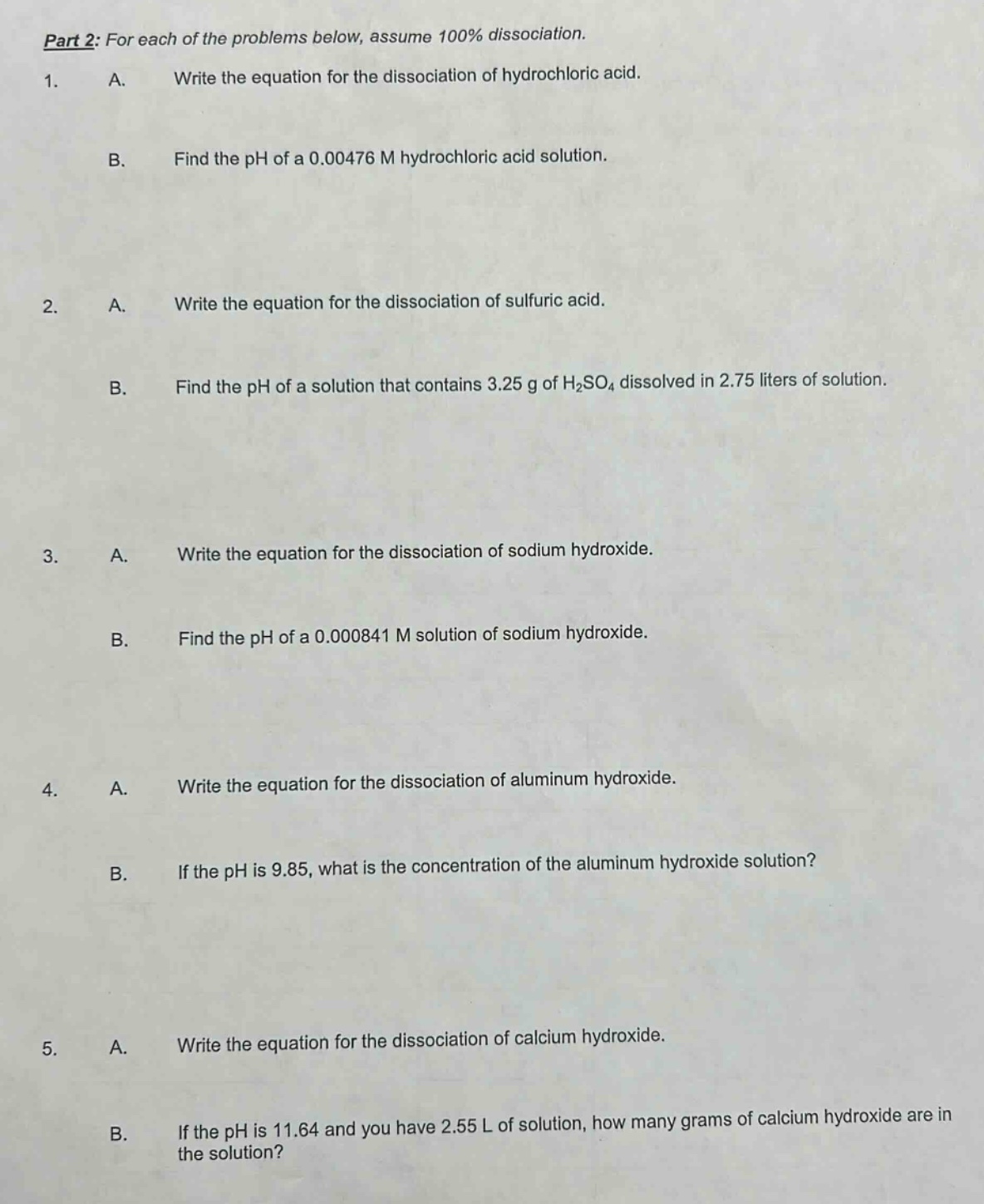
part 2: for each of the problems below, assume 100% dissociation.\n1. a. write the equation for the dissociation of hydrochloric acid.\nb. find the ph of a 0.00476 m hydrochloric acid solution.\n2. a. write the equation for the dissociation of sulfuric acid.\nb. find the ph of a solution that contains 3.25 g of h₂so₄ dissolved in 2.75 liters of solution.\n3. a. write the equation for the dissociation of sodium hydroxide.\nb. find the ph of a 0.000841 m solution of sodium hydroxide.\n4. a. write the equation for the dissociation of aluminum hydroxide.\nb. if the ph is 9.85, what is the concentration of the aluminum hydroxide solution?\n5. a. write the equation for the dissociation of calcium hydroxide.\nb. if the ph is 11.64 and you have 2.55 l of solution, how many grams of calcium hydroxide are in the solution?
Answer
1.
Answer:
A.
$HCl(aq)\rightarrow H^{+}(aq)+Cl^{-}(aq)$
B.
Answer:
2.32
Explanation:
Step1: Identify $[H^{+}]$ concentration
Since $HCl$ is a strong - acid and dissociates completely, $[H^{+}]=0.00476\ M$
Step2: Calculate pH
$pH =-\log[H^{+}]=-\log(0.00476)\approx2.32$
2.
Answer:
A.
$H_{2}SO_{4}(aq)\rightarrow 2H^{+}(aq)+SO_{4}^{2 -}(aq)$
B.
Answer:
1.34
Explanation:
Step1: Calculate molarity of $H_{2}SO_{4}$
The molar mass of $H_{2}SO_{4}$ is $M=(2\times1 + 32+4\times16)=98\ g/mol$. The number of moles of $H_{2}SO_{4}$, $n=\frac{m}{M}=\frac{3.25\ g}{98\ g/mol}\approx0.0332\ mol$. The molarity $M=\frac{n}{V}=\frac{0.0332\ mol}{2.75\ L}\approx0.0121\ M$.
Step2: Determine $[H^{+}]$ concentration
Since $H_{2}SO_{4}$ is a strong - acid and gives 2 moles of $H^{+}$ per mole of $H_{2}SO_{4}$, $[H^{+}]=2\times0.0121\ M = 0.0242\ M$
Step3: Calculate pH
$pH=-\log[H^{+}]=-\log(0.0242)\approx1.34$
3.
Answer:
A.
$NaOH(aq)\rightarrow Na^{+}(aq)+OH^{-}(aq)$
B.
Answer:
10.92
Explanation:
Step1: Identify $[OH^{-}]$ concentration
Since $NaOH$ is a strong - base and dissociates completely, $[OH^{-}]=0.000841\ M$
Step2: Calculate pOH
$pOH =-\log[OH^{-}]=-\log(0.000841)\approx3.08$
Step3: Calculate pH
$pH = 14 - pOH=14 - 3.08 = 10.92$
4.
Answer:
A.
$Al(OH)_{3}(s)\rightleftharpoons Al^{3 +}(aq)+3OH^{-}(aq)$
B.
Answer:
$7.08\times10^{-5}\ M$
Explanation:
Step1: Calculate pOH
$pOH=14 - pH=14 - 9.85 = 4.15$
Step2: Calculate $[OH^{-}]$ concentration
$[OH^{-}]=10^{-pOH}=10^{-4.15}\approx7.08\times10^{-5}\ M$
Step3: Determine $[Al(OH)_{3}]$ concentration
From the dissociation equation, for every mole of $Al(OH){3}$ that dissociates, 3 moles of $OH^{-}$ are produced. So $[Al(OH){3}]=\frac{[OH^{-}]}{3}=\frac{7.08\times10^{-5}\ M}{3}\approx2.36\times10^{-5}\ M$ (assuming complete dissociation and neglecting the solubility - product considerations for simplicity as per the 100% dissociation assumption). But if we consider the stoichiometry directly from the dissociation, since $[OH^{-}]$ is related to $[Al(OH){3}]$ by a 3:1 ratio, and we know $[OH^{-}]$, the concentration of $Al(OH){3}$ that would produce this $[OH^{-}]$ is $\frac{[OH^{-}]}{3}$. Since $[OH^{-}]=7.08\times10^{-5}\ M$, the concentration of $Al(OH)_{3}$ is $7.08\times10^{-5}\ M$ (because we are working backward from the $[OH^{-}]$ value to the original base concentration based on the stoichiometry of the dissociation).
5.
Answer:
A.
$Ca(OH)_{2}(s)\rightarrow Ca^{2 +}(aq)+2OH^{-}(aq)$
B.
Answer:
0.117 g
Explanation:
Step1: Calculate pOH
$pOH=14 - pH=14 - 11.64 = 2.36$
Step2: Calculate $[OH^{-}]$ concentration
$[OH^{-}]=10^{-pOH}=10^{-2.36}\approx4.37\times10^{-3}\ M$
Step3: Calculate moles of $OH^{-}$
The volume of the solution $V = 2.55\ L$. The number of moles of $OH^{-}$, $n_{OH^{-}}=[OH^{-}]\times V=4.37\times10^{-3}\ M\times2.55\ L\approx0.0111\ mol$
Step4: Calculate moles of $Ca(OH)_{2}$
From the dissociation equation, 1 mole of $Ca(OH){2}$ gives 2 moles of $OH^{-}$. So the number of moles of $Ca(OH){2}$, $n_{Ca(OH){2}}=\frac{n{OH^{-}}}{2}=\frac{0.0111\ mol}{2}=0.00555\ mol$
Step5: Calculate mass of $Ca(OH)_{2}$
The molar mass of $Ca(OH){2}$ is $M=(40+(2\times(16 + 1)))=74\ g/mol$. The mass of $Ca(OH){2}$, $m=n_{Ca(OH)_{2}}\times M=0.00555\ mol\times74\ g/mol = 0.117\ g$