periodic table\nsublimation is the process of a solid changing directly to a gas. which answer best explains…
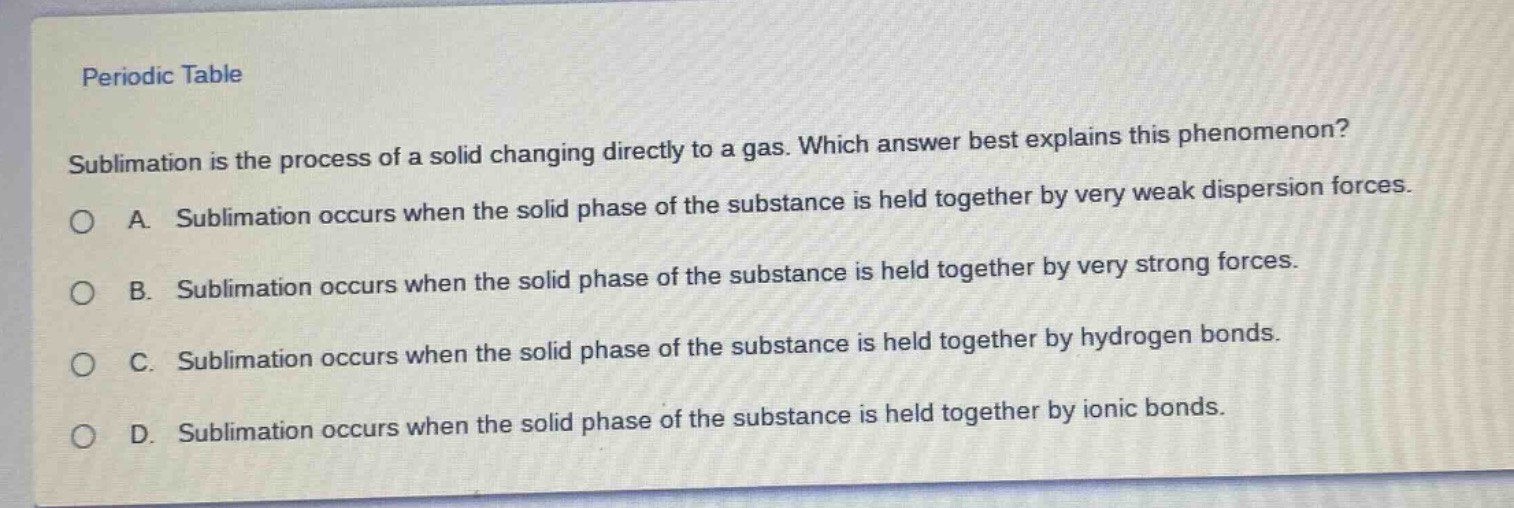
periodic table\nsublimation is the process of a solid changing directly to a gas. which answer best explains this phenomenon?\na. sublimation occurs when the solid phase of the substance is held together by very weak dispersion forces.\nb. sublimation occurs when the solid phase of the substance is held together by very strong forces.\nc. sublimation occurs when the solid phase of the substance is held together by hydrogen bonds.\nd. sublimation occurs when the solid phase of the substance is held together by ionic bonds.
Answer
Brief Explanations:
Sublimation happens when the forces holding the solid - phase particles together are weak, allowing them to transition directly to the gas phase without passing through the liquid phase. Dispersion forces are the weakest intermolecular forces. Strong forces (like in option B), hydrogen bonds (option C), and ionic bonds (option D) would keep the substance in a more ordered solid - state and make sublimation less likely.
Answer:
A. Sublimation occurs when the solid phase of the substance is held together by very weak dispersion forces.