the ph of a solution is a measure of how acidic it is. the greater the acidity, the lower the ph. the…
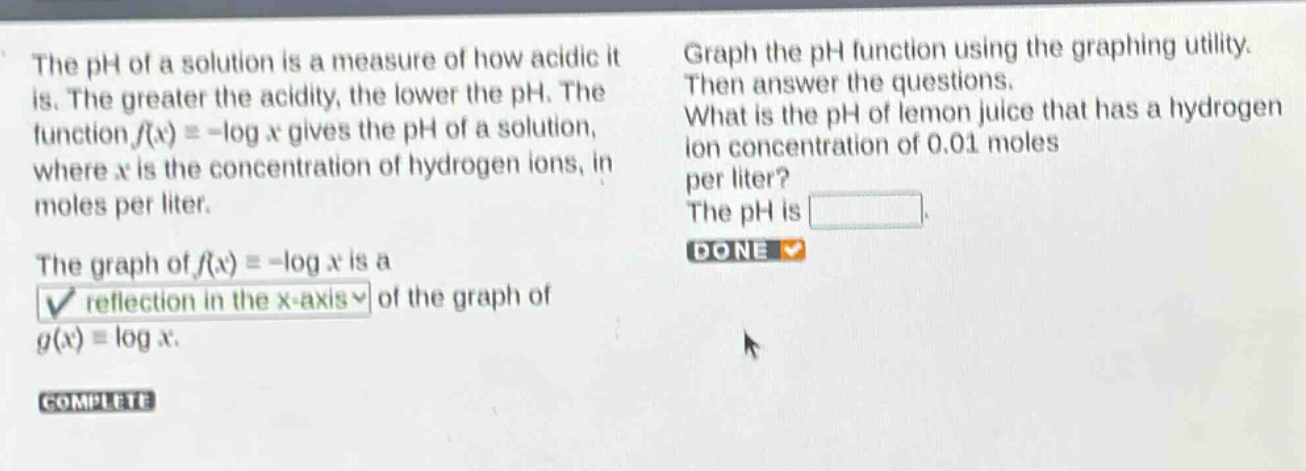
the ph of a solution is a measure of how acidic it is. the greater the acidity, the lower the ph. the function (f(x)=-log x) gives the ph of a solution, where (x) is the concentration of hydrogen ions, in moles per liter. the graph of (f(x)=-log x) is a reflection in the x - axis of the graph of (g(x)=log x). graph the ph function using the graphing utility. then answer the questions. what is the ph of lemon juice that has a hydrogen ion concentration of 0.01 moles per liter? the ph is
Answer
Explanation:
Step1: Identify the formula
We use the formula $pH =-\log(x)$, where $x$ is the hydrogen - ion concentration.
Step2: Substitute the value of $x$
Given $x = 0.01=\frac{1}{100}=10^{-2}$. Then $pH=-\log(10^{-2})$.
Step3: Apply the logarithm property
According to the logarithm property $\log(a^{b})=b\log(a)$, so $-\log(10^{-2})=-(- 2)\log(10)$. Since $\log(10) = 1$, we have $-(-2)\times1 = 2$.
Answer:
2