physical science reference guide questions\n1. a piece of paper is torn into many pieces. is this an example…
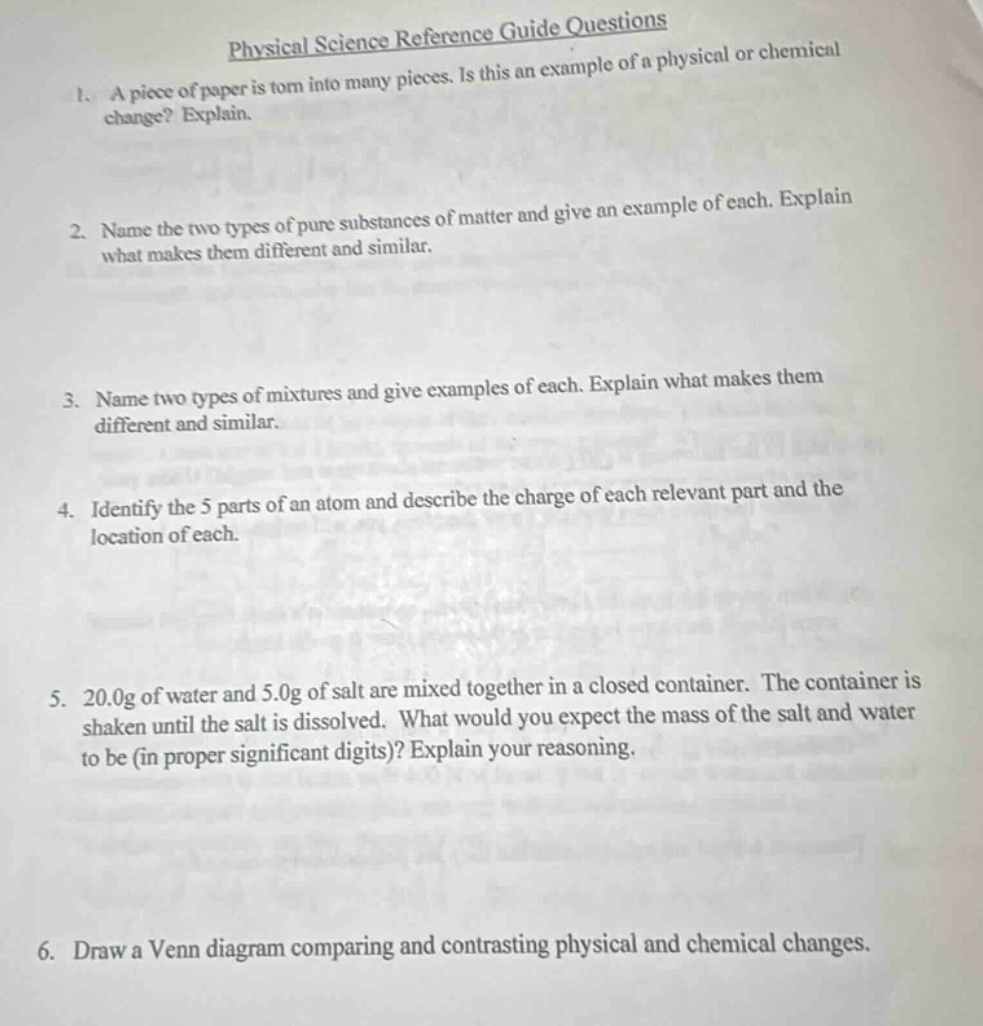
physical science reference guide questions\n1. a piece of paper is torn into many pieces. is this an example of a physical or chemical change? explain.\n2. name the two types of pure substances of matter and give an example of each. explain what makes them different and similar.\n3. name two types of mixtures and give examples of each. explain what makes them different and similar.\n4. identify the 5 parts of an atom and describe the charge of each relevant part and the location of each.\n5. 20.0g of water and 5.0g of salt are mixed together in a closed container. the container is shaken until the salt is dissolved. what would you expect the mass of the salt and water to be (in proper significant digits)? explain your reasoning.\n6. draw a venn diagram comparing and contrasting physical and chemical changes.
Answer
1.
Brief Explanations:
A physical change alters the form or appearance of a substance without changing its chemical composition. Tearing paper only changes its physical form, not its chemical makeup.
Answer:
This is a physical change. The paper's chemical composition remains the same; only its physical form (size and shape) has changed.
2.
Brief Explanations:
The two types of pure substances are elements and compounds. Elements consist of only one type of atom, like oxygen ($O$). Compounds are made of two or more different - type atoms chemically bonded, like water ($H_2O$). Both are pure substances as they have a definite and uniform composition.
Answer:
Elements (e.g., oxygen) and compounds (e.g., water). Elements are made of one - type of atom, while compounds are made of different types of atoms chemically combined. They are similar in that they are both pure substances with a fixed composition.
3.
Brief Explanations:
The two types of mixtures are homogeneous and heterogeneous. Homogeneous mixtures have a uniform composition throughout, like salt - water solution. Heterogeneous mixtures have non - uniform composition, like a mixture of sand and water. Both are mixtures, meaning they are composed of two or more substances that are not chemically combined.
Answer:
Homogeneous mixtures (e.g., salt - water solution) and heterogeneous mixtures (e.g., sand - water mixture). Homogeneous mixtures are uniform, while heterogeneous are non - uniform. They are similar as they are combinations of substances not chemically bonded.
4.
Brief Explanations:
The five parts of an atom are protons (positive charge, located in the nucleus), neutrons (no charge, located in the nucleus), electrons (negative charge, located in electron shells around the nucleus), positrons (positive charge, very rare in normal atoms, can be produced in some nuclear reactions), and neutrinos (no charge, produced in some nuclear processes and have very little interaction with matter).
Answer:
Protons: positive charge, in the nucleus; Neutrons: no charge, in the nucleus; Electrons: negative charge, in electron shells; Positrons: positive charge (rare in normal atoms); Neutrinos: no charge (produced in some nuclear processes).
5.
Brief Explanations:
According to the law of conservation of mass, in a closed system, the total mass before a physical or chemical process is equal to the total mass after the process. The mass of water is 20.0 g and the mass of salt is 5.0 g.
Answer:
The mass of the salt - water mixture is 25.0 g. Reasoning: By the law of conservation of mass, the total mass in a closed system is conserved. So, $20.0g + 5.0g=25.0g$.
6.
Brief Explanations:
In a Venn diagram, the overlapping part can represent changes that involve energy transfer (both physical and chemical changes can involve energy changes). The non - overlapping part for physical changes can include changes like changes in state (melting, freezing), shape, or size. The non - overlapping part for chemical changes can include the formation of new substances with different chemical properties.
Answer:
Draw two overlapping circles. Label one "Physical Changes" and the other "Chemical Changes". In the overlapping region, write "Energy transfer can occur". In the non - overlapping part of the "Physical Changes" circle, write "Changes in state, shape, size". In the non - overlapping part of the "Chemical Changes" circle, write "Formation of new substances with different chemical properties".