4. a piece of plastic with a mass of 15 g is placed in a graduated cylinder. the water level in the…
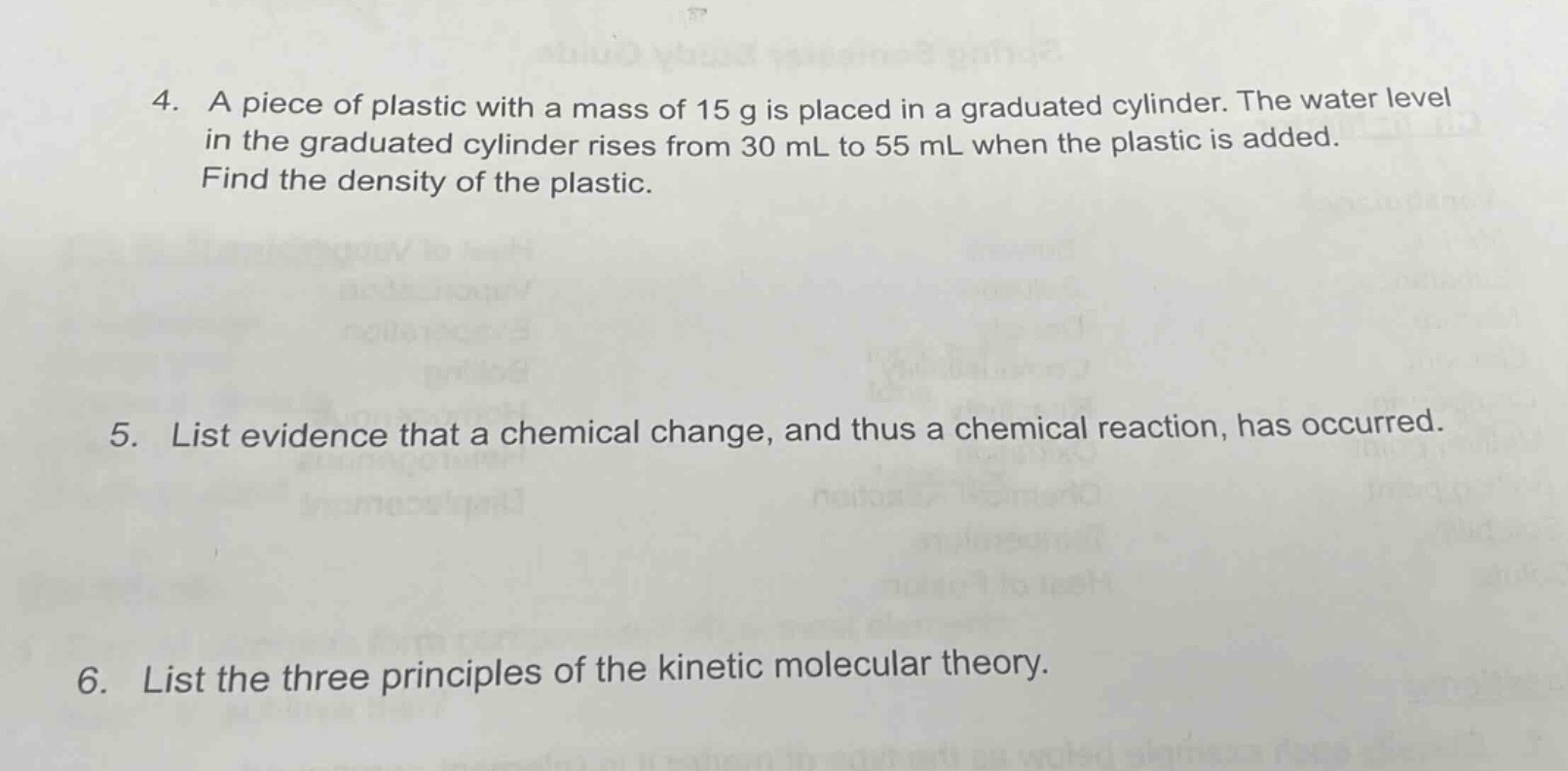
4. a piece of plastic with a mass of 15 g is placed in a graduated cylinder. the water level in the graduated cylinder rises from 30 ml to 55 ml when the plastic is added. find the density of the plastic.\n5. list evidence that a chemical change, and thus a chemical reaction, has occurred.\n6. list the three principles of the kinetic molecular theory.
Answer
4.
Explanation:
Step1: Find the volume of the plastic
The volume of the plastic is equal to the volume of water displaced. The initial water - level is $V_1 = 30\ mL$ and the final water - level is $V_2=55\ mL$. So, $V = V_2 - V_1$. $V=55\ mL - 30\ mL=25\ mL$
Step2: Calculate the density of the plastic
The density formula is $\rho=\frac{m}{V}$, where $m = 15\ g$ and $V = 25\ mL$. $\rho=\frac{15\ g}{25\ mL}=0.6\ g/mL$
Answer:
$0.6\ g/mL$
5.
Brief Explanations:
The evidence of a chemical change includes color change, formation of a precipitate, evolution of a gas, temperature change (exothermic or endothermic), and change in odor.
Answer:
Color change, formation of a precipitate, evolution of a gas, temperature change, change in odor
6.
Brief Explanations:
- Gases are made up of molecules which are in continuous random motion in straight lines.
- The molecules of a gas are very small compared to the distance between them.
- The pressure exerted by a gas is due to the collisions of the gas molecules with the walls of the container.
Answer:
- Gas molecules are in continuous random straight - line motion.
- Gas molecules are small relative to the distance between them.
- Gas pressure is due to molecule - wall collisions.